Outcome
A unit-based rent roll uses the correct inventory labels, counts, areas, rents, and vacancy records.
Navigation path
Document wizard > Rent Roll
Access
A financial scope that includes Rent Roll
On this page
Before you start
Data, sources, and access to prepare
- A supported unit-based property type
- Unit, storage, or pad inventory
- Current rents and occupancy status
Match the inventory to the property
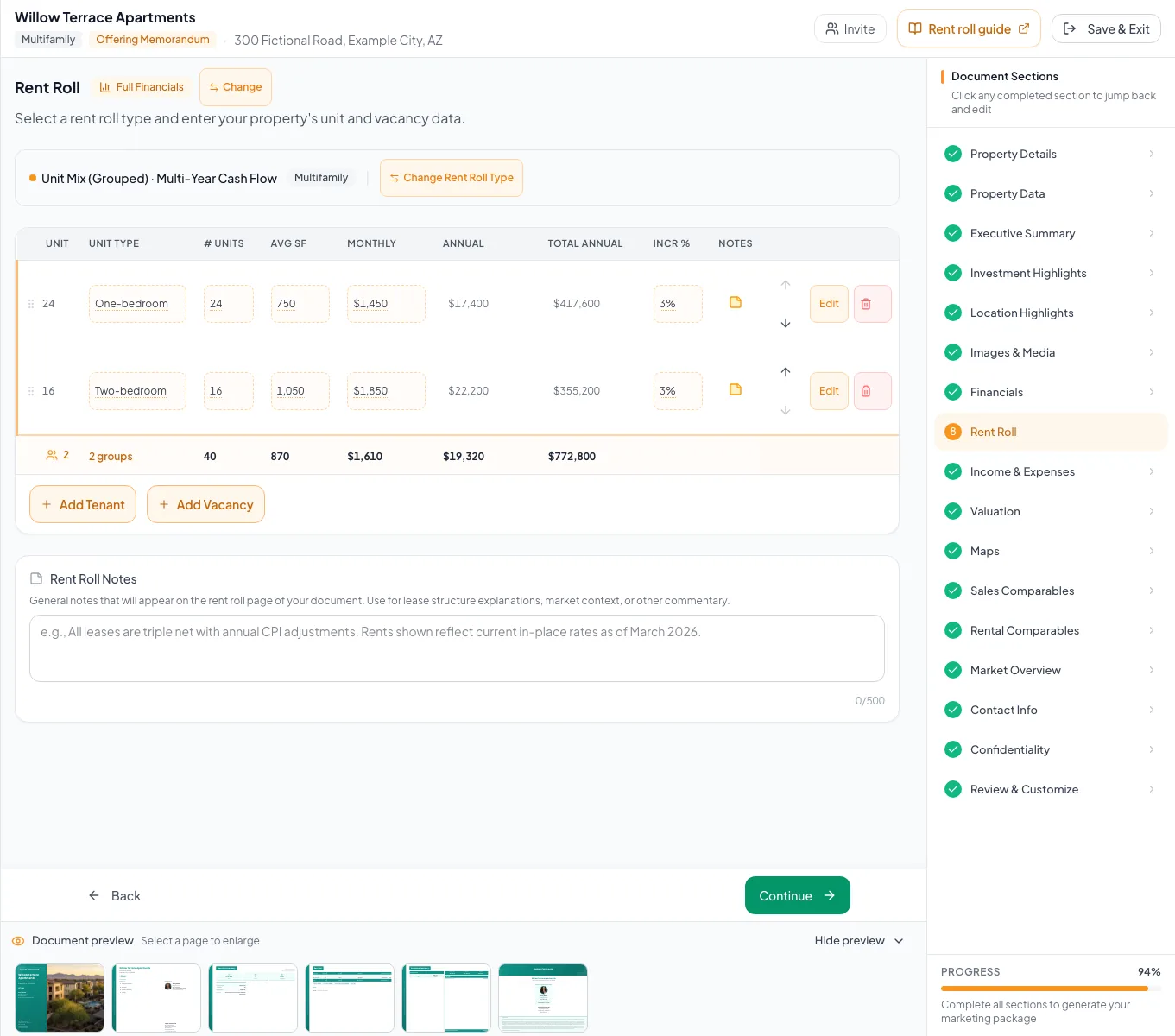
Unit-based inventory
The same calculation framework changes labels and reserve bases by property type.
Source roster
Choose individual records or grouped types
Multifamily
Units and Unit Mix
Self-Storage
Units and Unit Inventory
Mobile Home Parks
Pads and Pad Inventory
Annual rent
Count x monthly or annual rent where grouped
- Source rosterMultifamily
- Source rosterSelf-Storage
- Source rosterMobile Home Parks
- MultifamilyAnnual rent
- Self-StorageAnnual rent
- Mobile Home ParksAnnual rent
| Property type | Primary labels | Rent basis | Fields not shown |
|---|---|---|---|
| Multifamily | Units, Unit Mix | Monthly or Annual | Lease dates and reimbursements |
| Self-Storage | Units, Unit Inventory | Monthly or Annual | Lease dates and reimbursements |
| Mobile Home Parks | Pads, Pad Inventory, Gross Pad Income | Monthly or Annual | Lease dates and reimbursements |
Complete individual or grouped fields
| Field | Requirement | What it means | Format | Units | Save behavior | Downstream effect |
|---|---|---|---|---|---|---|
| Unit Type | Required | Floor plan, storage size, or pad category. | Plain-text category or unit label | Not applicable | Saved when the unit or grouped-row drawer Save action succeeds. | Labels the inventory row in the property-specific Rent Roll output. |
| Number of Units | Required | How many repeated records the Unit Mix row represents. | Positive whole number | Units, storage units, or pads | Saved when the grouped-row drawer Save action succeeds. | Multiplies per-unit rent and area and contributes to total inventory and occupancy. |
| Average SF | Recommended | Average area for the row. | Nonnegative number | Square feet per unit or pad | Saved when the unit or grouped-row drawer Save action succeeds. | Contributes to row and portfolio area summaries where the property presentation uses them. |
| Monthly or Annual Rent | Recommended | Current average or individual rent in the selected basis. | Currency amount plus Monthly or Annual basis | Currency per unit per month or per year | Saved when the unit or grouped-row drawer Save action succeeds. | Annualizes per-unit rent, multiplies grouped rows by count, and feeds current base rent. |
| Pro Forma Rent | Optional | Stabilized rent shown only in a Pro Forma model. | Currency amount | Currency per unit in the selected rent basis | Saved with the row when the Pro Forma drawer Save action succeeds. | Feeds the stabilized rent column and Pro Forma comparison without replacing In-Place rent. |
| Vacancy | Recommended | Unoccupied unit or grouped vacancy record. | Vacancy row or vacancy status in the available editor | Not applicable | Saved when the vacancy row or inventory row Save action succeeds. | Keeps physical capacity in total inventory while separating vacant count and vacancy analysis. |
Required means the field is needed to complete or support this workflow. Some screens allow a draft to save before every required item is complete. The steps and troubleshooting call out controls the product actively blocks.
Build the inventory
Unit-based rent-roll steps
- 1
Choose the layout
Rent Roll Type
Select Unit-by-Unit for individual records or Unit Mix for repeated categories, plus Cash Flow or Pro Forma.
Expected result: The property-specific inventory columns appear.
If this does not happen: Compare the source schedule to the model matrix if the needed fields are absent.
- 2
Add an inventory row
Rent Roll toolbar
Select the control for adding a unit or category.
Expected result: The detail drawer opens for a new row.
If this does not happen: Choose the rent-roll layout first if the control is unavailable.
- 3
Complete the inventory row
Rent Roll detail drawer
Enter name or type, grouped count, average SF, and rent basis as applicable.
Expected result: The row appears with calculated monthly and annual totals after save.
If this does not happen: Verify count and Monthly versus Annual if the total is wrong.
- 4
Represent vacancy
Rent Roll toolbar
Add vacancy rows or vacant inventory categories instead of omitting physical capacity.
Expected result: Inventory and vacancy remain visible in the model.
If this does not happen: Reconcile total occupied plus vacant count with the source property count.
- 5
Enter cash-flow growth
Detail drawer > Multi-Year Cash Flow
Enter the applicable growth assumption.
Expected result: The row contains the growth value used by the cash-flow projection.
If this does not happen: If the growth field is absent, revisit Rent Roll Type before continuing.
- 6
Enter stabilized rent
Detail drawer > Pro Forma
Enter the stabilized rent amount.
Expected result: The row contains the rent value used by the pro-forma comparison.
If this does not happen: If the stabilized rent field is absent, revisit Rent Roll Type before continuing.
- 7
Reconcile totals
Rent Roll summary
Compare unit or pad count, average area, monthly rent, and annual total with the source roster.
Expected result: Displayed totals tie to the source.
If this does not happen: Open the first mismatched row and correct count, rent, or basis.
Resolve inventory mismatches
Total rent is multiplied unexpectedly
Likely cause: A Unit Mix count represents repeated units and multiplies the entered rent.
- Confirm the count.
- Confirm the rent is per unit, not already the total for the group.
Lease or reimbursement fields are missing
Likely cause: These unit-based property configurations intentionally hide them.
- Use the available unit economics fields.
- Add concise reader-facing context in notes if needed.
Inventory count does not match property details
Likely cause: Vacant units may have been omitted or categories may overlap.
- Add explicit vacancy inventory.
- Reconcile each category count before continuing.
Inventory complete
- Labels match the property type
- Counts include occupied and vacant inventory
- Rent is entered per unit or pad when grouped
- Annual totals reconcile
- Projection fields match Cash Flow or Pro Forma
Related guides
Choose a rent-roll model and layout
Choose the projection axis and detail axis that determine the rent-roll fields, calculations, and analysis page.
Open guideBuild a Multifamily document
Use unit-based occupancy, monthly or annual rent, unit mix, Price/Unit, and multifamily income sources.
Open guideBuild a Self-Storage document
Use Unit Inventory, monthly or annual rent, unit occupancy, Price/Unit, and storage-specific income and reserve labels.
Open guideBuild a Mobile Home Park document
Use Pad Inventory, monthly or annual lot rent, pad occupancy, Price/Pad, and park-specific income and reserve labels.
Open guide