Outcome
The in-place and pro-forma columns reconcile independently and communicate the intended stabilization case.
Navigation path
Document wizard > Rent Roll > Pro Forma > Income & Expenses > Valuation
Access
Full Financials with a Pro Forma rent-roll model
On this page
Before you start
Data, sources, and access to prepare
- Full Financials selected
- A Unit-by-Unit Pro Forma or Unit-Mix Pro Forma rent-roll type
- Current and stabilized assumptions
Understand the Pro Forma comparison
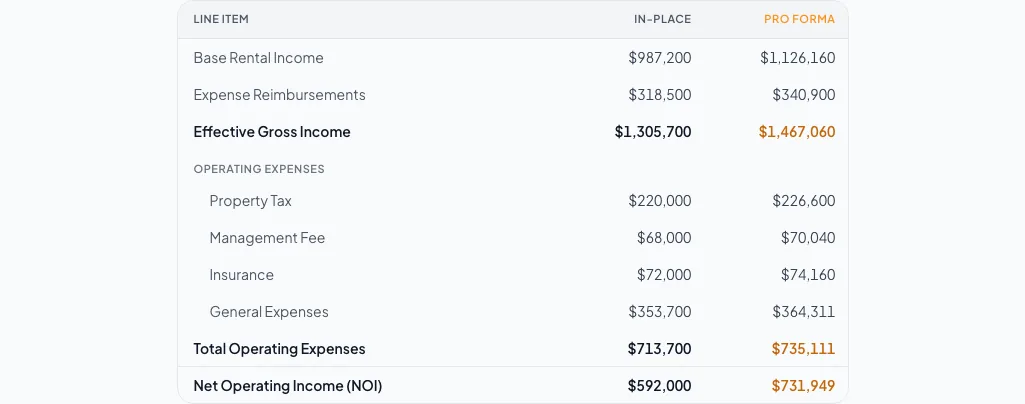
In-place to pro forma
The two columns are separate snapshots, not Year 0 and Year 1.
In-Place Rent
Current tenant or unit economics
Pro Forma Rent
Stabilized tenant or unit economics
In-Place NOI
Current EGI less current expenses
Pro Forma NOI
Stabilized EGI less stabilized expenses
Pro Forma Analysis
Side-by-side output
- In-Place RentIn-Place NOI
- Pro Forma RentPro Forma NOI
- In-Place NOIPro Forma Analysis
- Pro Forma NOIPro Forma Analysis
| Area | In-Place | Pro Forma |
|---|---|---|
| Rent Roll | Current rent and reimbursement | Stabilized rent and reimbursement |
| Additional Income | Current annual amount | Stabilized annual amount |
| Expenses | Current annual amount | Stabilized annual amount |
| Valuation | Current EGI, expenses, NOI | Stabilized EGI, expenses, NOI |
| Growth schedules | Not shown | Not shown |
Reconcile the summary math
- In-place gross potential rent uses saved current tenant or unit rent.
- Pro-forma gross potential rent uses saved pro-forma rent for tenants and vacancies.
- Each side includes its corresponding reimbursement and additional-income values.
- Each side subtracts its corresponding total operating expenses.
- NOI equals effective gross income less operating expenses for that column.
- Pro Forma is not a time-based projection and does not apply annual growth or custom escalation schedules.
Build both sides of the analysis
Pro-forma steps
- 1
Choose Pro Forma
Rent Roll, projection selector
Select Pro Forma.
Expected result: The projection choice is highlighted.
If this does not happen: If annual growth is required instead, choose Multi-Year Cash Flow.
- 2
Choose the row layout
Rent Roll, layout selector
Select Unit-by-Unit or Unit Mix.
Expected result: Current and pro-forma input columns appear in the selected layout.
If this does not happen: Choose the layout that matches individual records or grouped source data.
- 3
Complete both rent cases
Rent Roll rows and detail drawer
Enter current and pro-forma rent and reimbursement for every applicable row.
Expected result: Each row has a complete two-column comparison.
If this does not happen: Do not leave a pro-forma field blank merely because the current value is unchanged. Enter the approved stabilized value.
- 4
Complete both statement cases
Income & Expenses
Enter In-Place and Pro Forma values for every additional-income and expense row.
Expected result: Both column totals reconcile to the underwriting.
If this does not happen: Check for explicit zero values and omitted rows separately.
- 5
Review the NOI table
Valuation, Pro Forma Analysis
Compare gross rent, reimbursements, other income, EGI, expenses, and NOI for both columns.
Expected result: Each subtotal can be traced to a saved input.
If this does not happen: Return to the source row for the first subtotal that differs.
- 6
Set optional financing and reserves
Valuation, Assumptions
Enter financing and reserve inputs only if they are part of the approved presentation.
Expected result: Optional below-NOI context saves.
If this does not happen: Verify reserve dollars independently before publishing.
- 7
Verify the document page
Review & Customize
Confirm the generated analysis is labeled and presented as a pro-forma comparison.
Expected result: The final page matches the two wizard columns.
If this does not happen: Return to the wizard if the output uses an unexpected model or value.
Avoid common pro-forma mistakes
Growth or exit-year controls are missing
Likely cause: Pro Forma is a two-snapshot comparison, not Multi-Year Cash Flow.
- Use current and stabilized columns.
- Change the rent-roll projection only if a yearly forecast is required.
An explicit zero becomes unclear
Likely cause: A blank field and a zero can carry different underwriting meaning.
- Enter zero deliberately where the modeled amount is zero.
- Review the resulting summary before leaving.
Pro-forma NOI is unexpectedly inflated
Likely cause: Vacant inventory, reimbursement, rent, or expense assumptions may have been populated inconsistently.
- Reconcile pro-forma gross rent first.
- Then reimbursements and additional income.
- Then expenses and NOI.
Comparison approved
- Every row has an intentional current value
- Every row has an intentional stabilized value
- Both EGI totals reconcile
- Both expense totals reconcile
- Both NOI values reconcile
- The output is presented as Pro Forma, not annual cash flow
Related guides
Choose a rent-roll model and layout
Choose the projection axis and detail axis that determine the rent-roll fields, calculations, and analysis page.
Open guideEnter income and operating expenses
Build the non-rental income and operating expense statement used to calculate effective gross income and NOI.
Open guideVerify financial pages before publishing
Confirm scope-based page inclusion, property-specific exceptions, calculations, footnotes, and final document presentation.
Open guide