Outcome
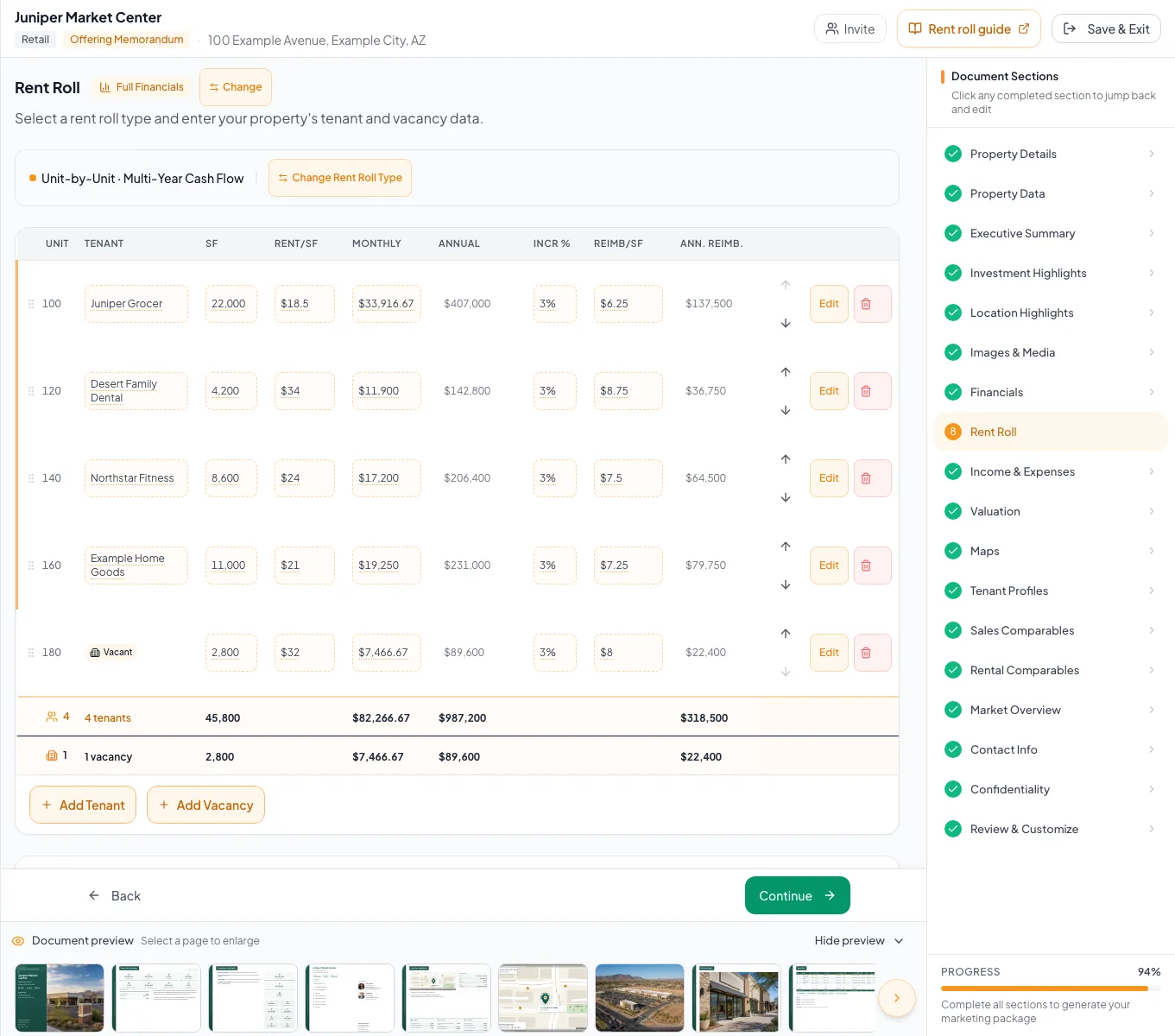
Tenant growth and reimbursement revenue follow the intended lease economics in every projected year.
Navigation path
Document wizard > Rent Roll > Edit Tenant > Rent Increases and Reimbursements
Access
Full Financials with Multi-Year Cash Flow
On this page
Before you start
Data, sources, and access to prepare
- A Unit-by-Unit Multi-Year Cash Flow rent roll
- Current annual rent
- Lease escalation and recovery terms
Choose the growth method
Rent growth decision
Use one annual rate for repeating bumps or a schedule for lease-specific changes.
Read lease terms
Identify timing and amount
Annual increase
Same percentage compounds each analysis year
Custom schedule
Specific analysis years use percentage or replacement annual rent
Preview
Verify every projected year
- Read lease termsAnnual increaseRepeating
- Read lease termsCustom scheduleIrregular
- Annual increasePreview
- Custom schedulePreview
| Step | Effect in selected analysis year | Later years |
|---|---|---|
| Increase by percent | Prior annual rent x (1 + percent) | New amount remains the base until another step |
| Set annual rent | Replaces annual rent with the entered dollar amount | Replacement amount remains until another step |
Annualize reimbursements
| Field | Requirement | What it means | Format | Units | Save behavior | Downstream effect |
|---|---|---|---|---|---|---|
| Reimbursement Amount | Optional | Expense recovery paid by the tenant. | Nonnegative currency amount | Currency in the selected reimbursement basis | Saved with the tenant drawer when Save Changes succeeds. | Combines with the selected basis and tenant area to calculate annual reimbursement. |
| Reimbursement Basis | Recommended | SF/Yr, SF/Mo, Annual, or Monthly. A blank legacy value is legal but uses a different fallback by column. | Select one supported basis; do not leave it blank when reviewing or editing a tenant | Not applicable | Saved with the tenant drawer when Save Changes succeeds. If a legacy in-place basis is blank, the calculation falls back to SF/Yr. If a legacy pro forma basis is blank, it falls back to Annual. | Determines whether the amount is multiplied by area, by 12 months, by both, or neither. The asymmetric blank fallback can change annual reimbursement materially, so select and verify both columns explicitly. |
| Reimbursement Growth | Optional | Annual growth applied in cash-flow years. | Percentage | Percent per projected year | Saved with the tenant drawer when Save Changes succeeds. | Compounds annual tenant reimbursement after In-Place in Multi-Year Cash Flow. |
Required means the field is needed to complete or support this workflow. Some screens allow a draft to save before every required item is complete. The steps and troubleshooting call out controls the product actively blocks.
Enter and verify the lease terms
Escalation and recovery steps
- 1
Open the tenant
Rent Roll, tenant row
Select Edit for the tenant.
Expected result: The current annual rent and growth controls are visible.
If this does not happen: Confirm the rent-roll projection is Multi-Year Cash Flow if the controls are missing.
- 2
Choose Annual or Custom
Tenant detail, Rent Increases
Use Annual for the same percentage every year or Custom for year-specific changes.
Expected result: The matching rate or schedule editor appears.
If this does not happen: Re-read the lease abstract if the change dates or amounts are uncertain.
- 3
Add complete custom steps
Custom escalation editor
Complete each change row with analysis Year N and either a percent or replacement annual amount.
Expected result: The preview sorts the steps and shows projected annual rent.
If this does not happen: Complete both the year and value. Remove partial rows before saving.
- 4
Review amount warnings
Custom escalation editor
If a replacement amount is far below current annual rent, verify that a monthly figure was not entered as annual.
Expected result: The replacement reflects the intended annual figure.
If this does not happen: Use the offered x12 correction only when it matches the lease source. Legitimate reductions may remain.
- 5
Enter reimbursement terms
Tenant detail, Reimbursements
Complete the reimbursement fields with recovery amount, basis, and applicable growth. For legacy blank bases, remember that in-place falls back to SF/Yr while pro forma falls back to Annual.
Expected result: The annual reimbursement calculates from the explicitly selected basis.
If this does not happen: Check area and basis first if the result is off by 12 or by the tenant SF. Do not assume the two blank-column fallbacks match.
- 6
Save the tenant schedule
Tenant drawer > Save Changes
Select Save Changes.
Expected result: The tenant drawer closes or reports a saved state.
If this does not happen: Keep the drawer open while a save is processing.
- 7
Inspect the projection
Valuation > cash-flow preview
Review projected rent and reimbursement rows by year.
Expected result: Each year follows the intended schedule.
If this does not happen: Return to the tenant schedule and correct the first year where the preview diverges.
Avoid projection mistakes
A custom step is ignored
Likely cause: The year or value is incomplete or invalid.
- Enter a whole analysis year of 1 or greater.
- Enter a finite percent or a nonnegative annual amount.
- Save and inspect the preview again.
The calendar label and lease anniversary feel different
Likely cause: The engine applies whole analysis-year steps, while a start date can make the preview label easier to read.
- Model the change in the intended analysis Year N.
- Use the date label as context, not as monthly proration.
Vacancy has no custom schedule
Likely cause: Vacancy rows use a simple annual growth percentage.
- Enter the available vacancy growth rate.
- Explain a more complex assumption in the rent-roll notes if necessary.
No lease-date proration
The current cash-flow engine projects whole analysis years. Lease start and end dates are descriptive and do not automatically prorate annual rent or stop revenue.
Final verification
- Custom escalation editor: The replacement reflects the intended annual figure.
- Tenant detail, Reimbursements: The annual reimbursement calculates from the explicitly selected basis.
- Tenant drawer > Save Changes: The tenant drawer closes or reports a saved state.
- Valuation > cash-flow preview: Each year follows the intended schedule.
- No blocking warning, failed status, or unresolved validation message remains in the completed workflow.
Related guides
Build a commercial rent roll
Add tenants and vacancies, enter rent in the correct basis, and complete lease and reimbursement details for commercial assets.
Open guideSet cash-flow assumptions
Configure the analysis period, vacancy and lease-up, exit pricing, financing, and property-specific reserves.
Open guideRead and verify the cash-flow projection
Trace rent, vacancy, reimbursements, additional income, expenses, reserves, debt, and exit value through the annual projection.
Open guide