Outcome
Your CRM starts with the appropriate pipeline, scripts, rules, and Mail prerequisites, and you can move from new activity to a documented next action without duplicate people.
Navigation path
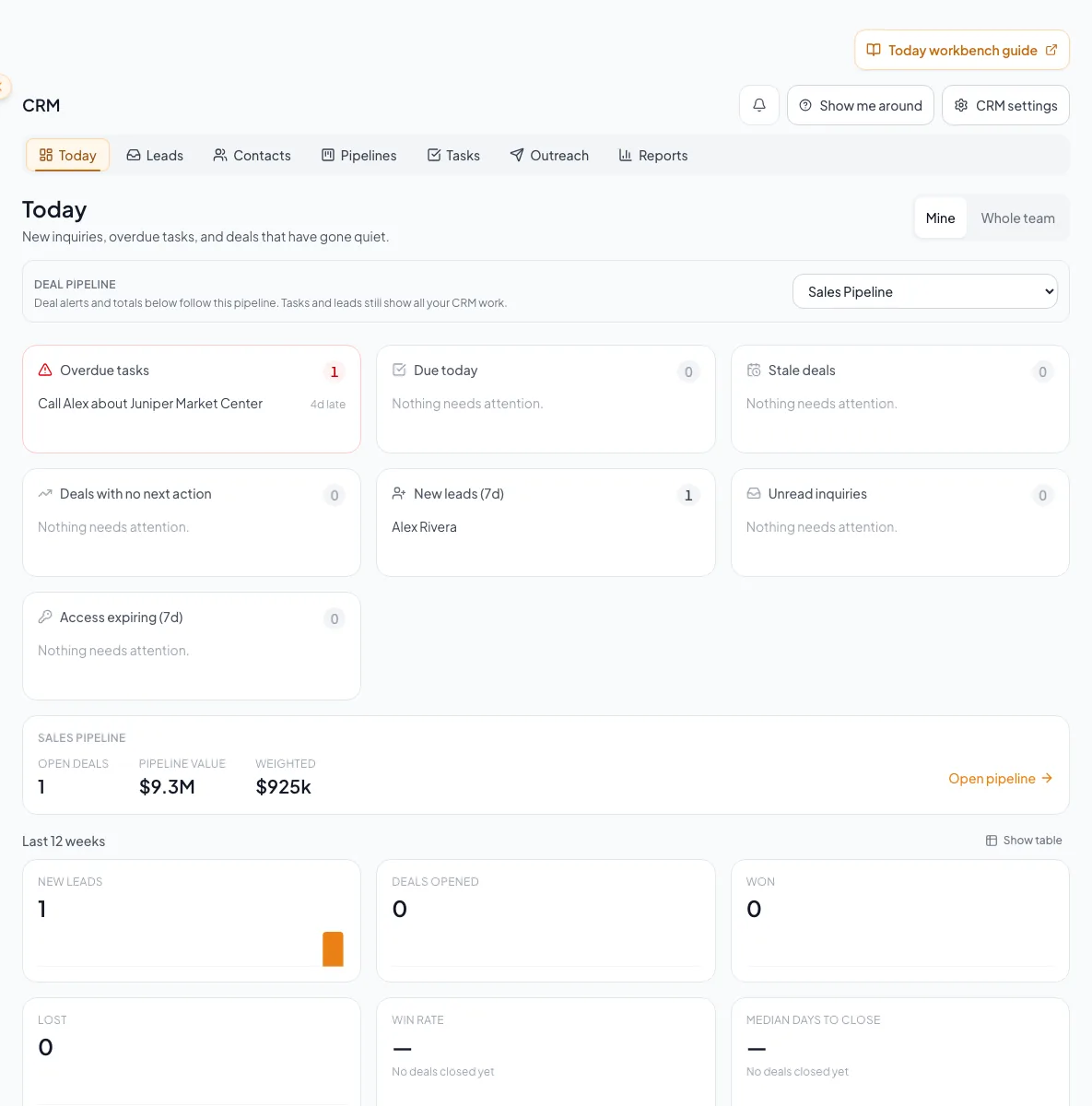
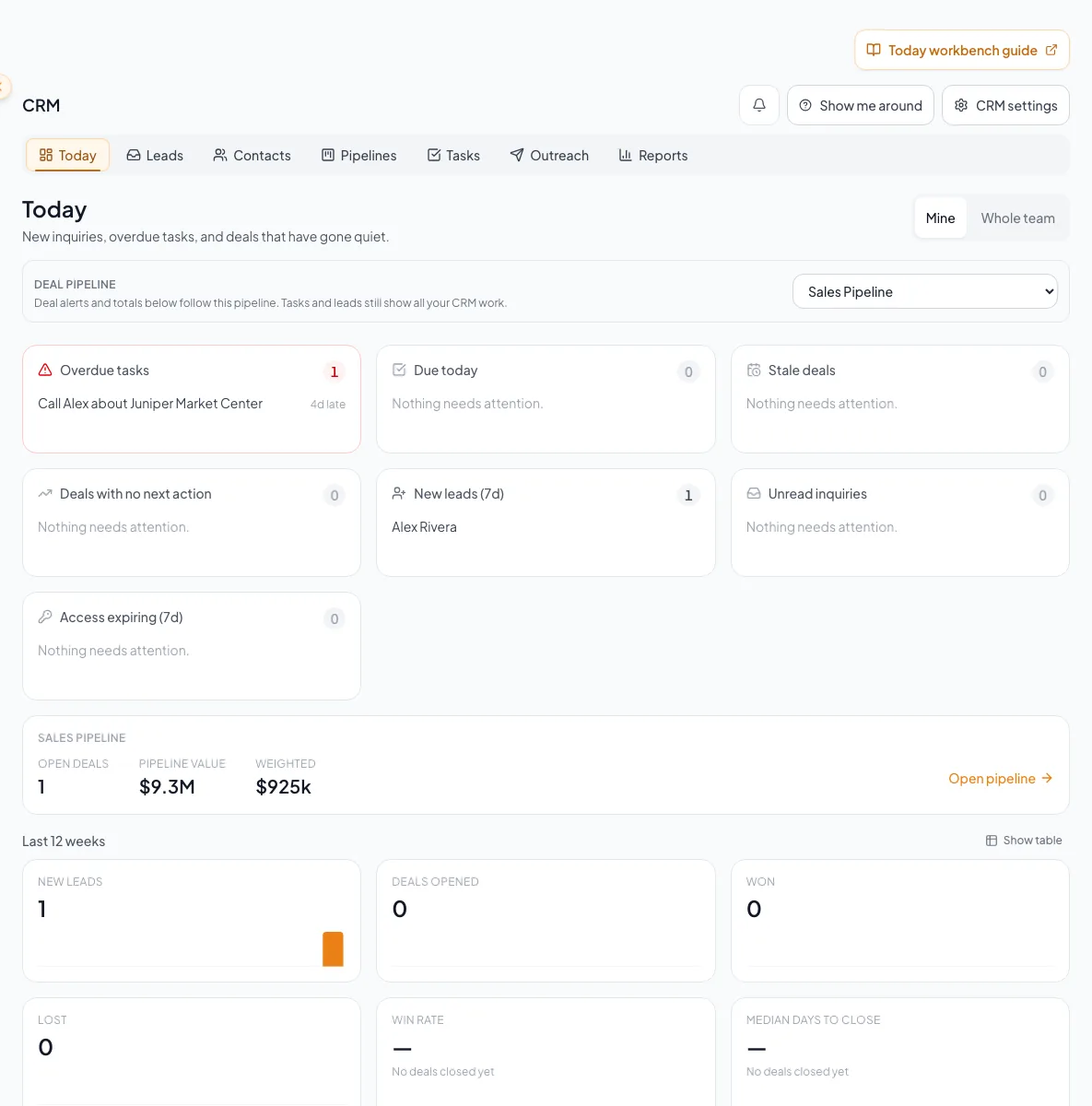
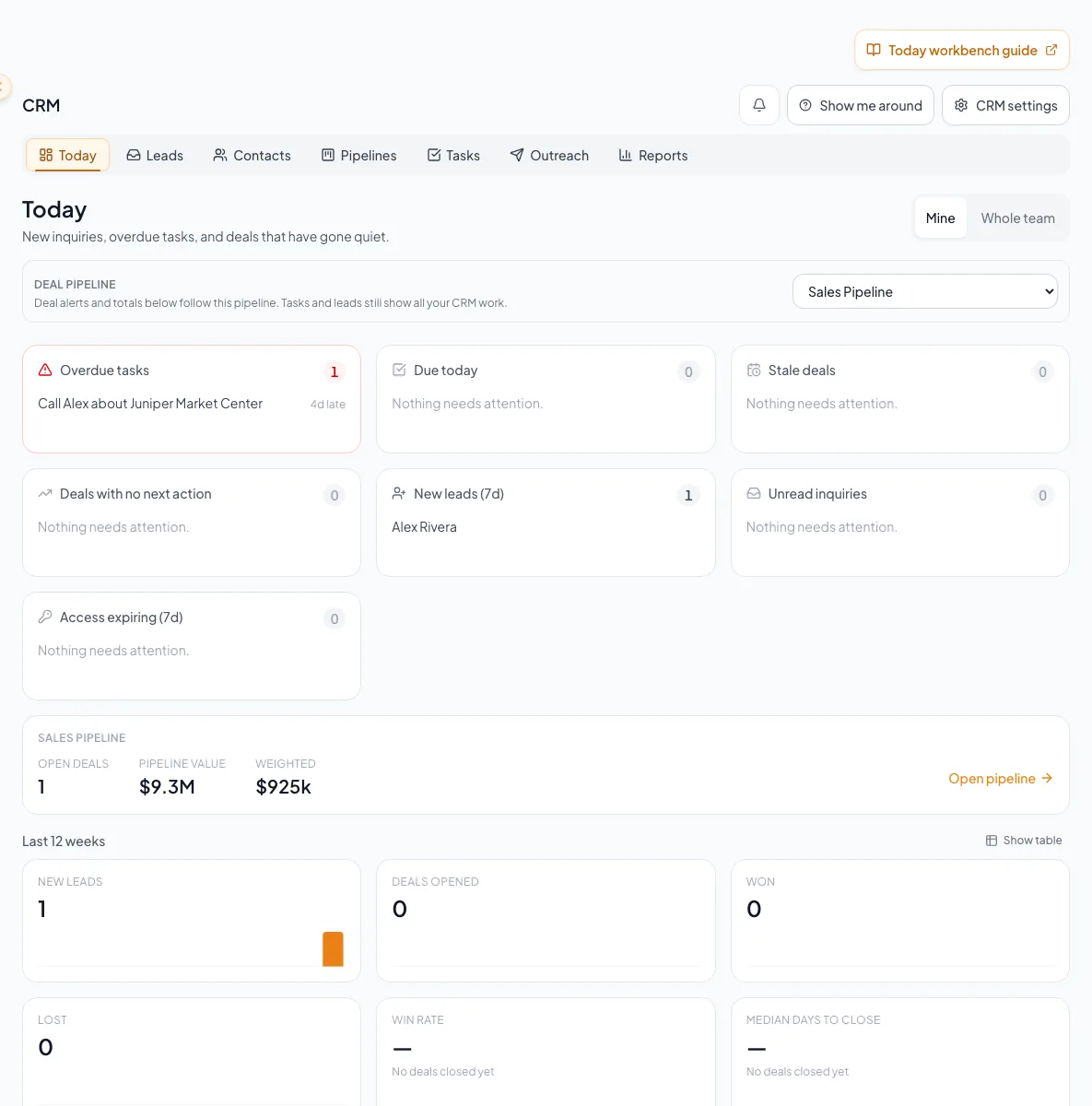
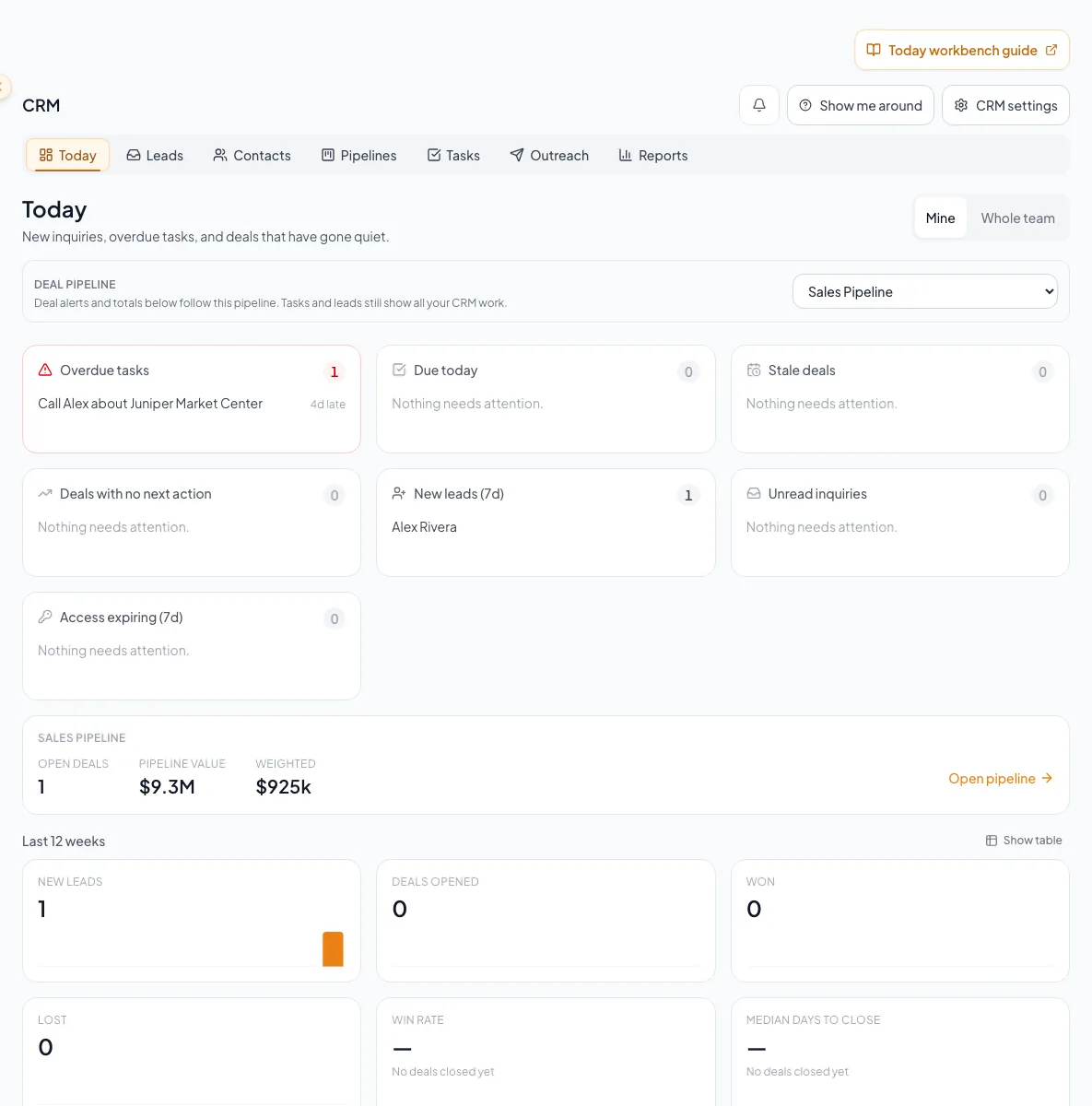
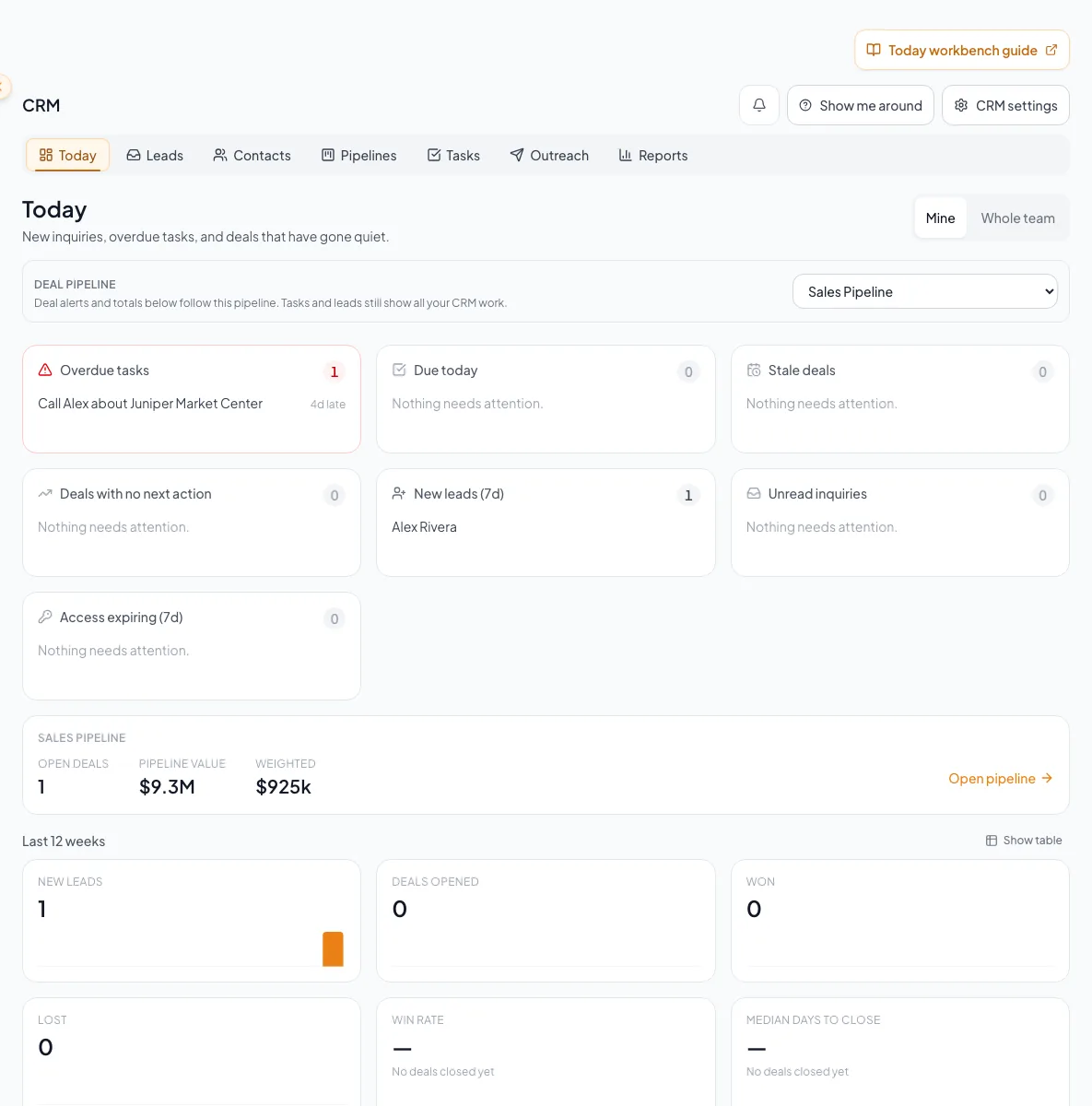
CRM > Today
Access
Active CREBuilder subscription with CRM entitlement
On this page
Before you start
Data, sources, and access to prepare
- An active CREBuilder subscription with CRM access
- A decision about whether the company handles property deals, business sales, or both
Start with the CRM record model
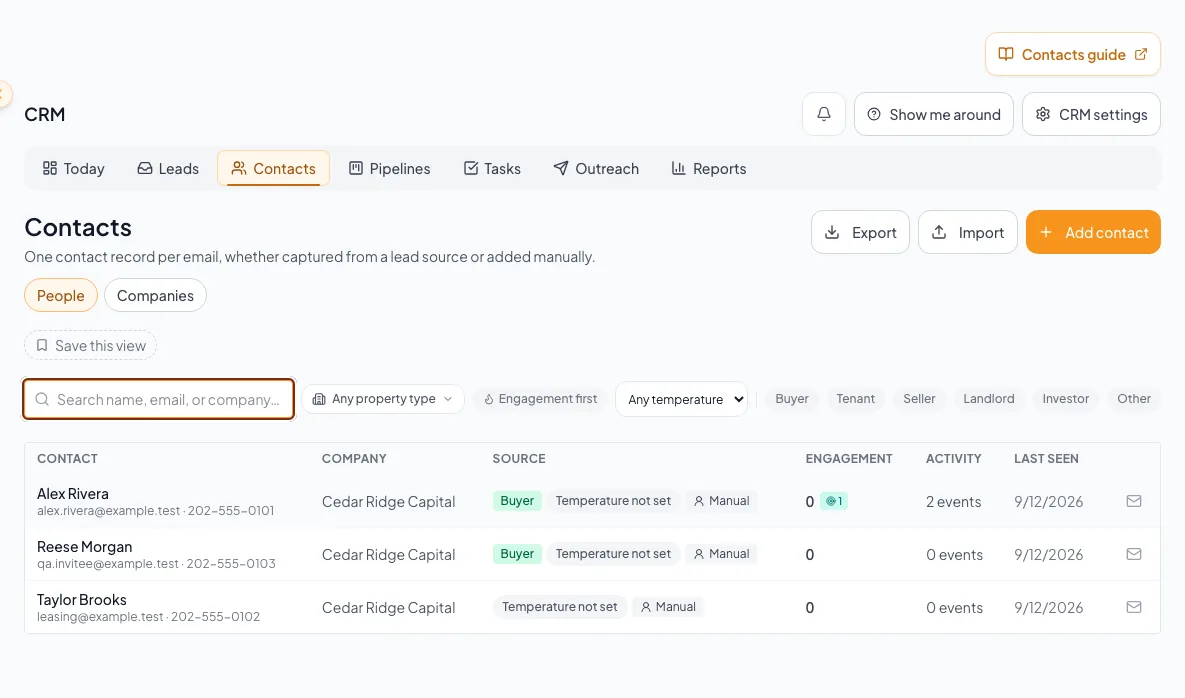
CREBuilder keeps one canonical person per normalized email address. Leads is an activity inbox over those people, not a separate database that needs conversion.
How activity becomes follow-up
Captured engagement resolves to one person, appears in Leads, and can then drive requirements, tasks, or pipeline work.
Inquiry, NDA, room, manual entry, or import
Canonical person
Matched by normalized email
Lead activity
Source and property context
Requirement, task, or pipeline record
- Inquiry, NDA, room, manual entry, or importCanonical personresolve
- Canonical personLead activitysurface
- Lead activityRequirement, task, or pipeline recordqualify
Add Lead does not create a second person
Add Contact and Add Lead use the same form. Add Lead adds a lead activity marker to the canonical person, so there is no conversion button or duplicate lead object.
Know where each job belongs
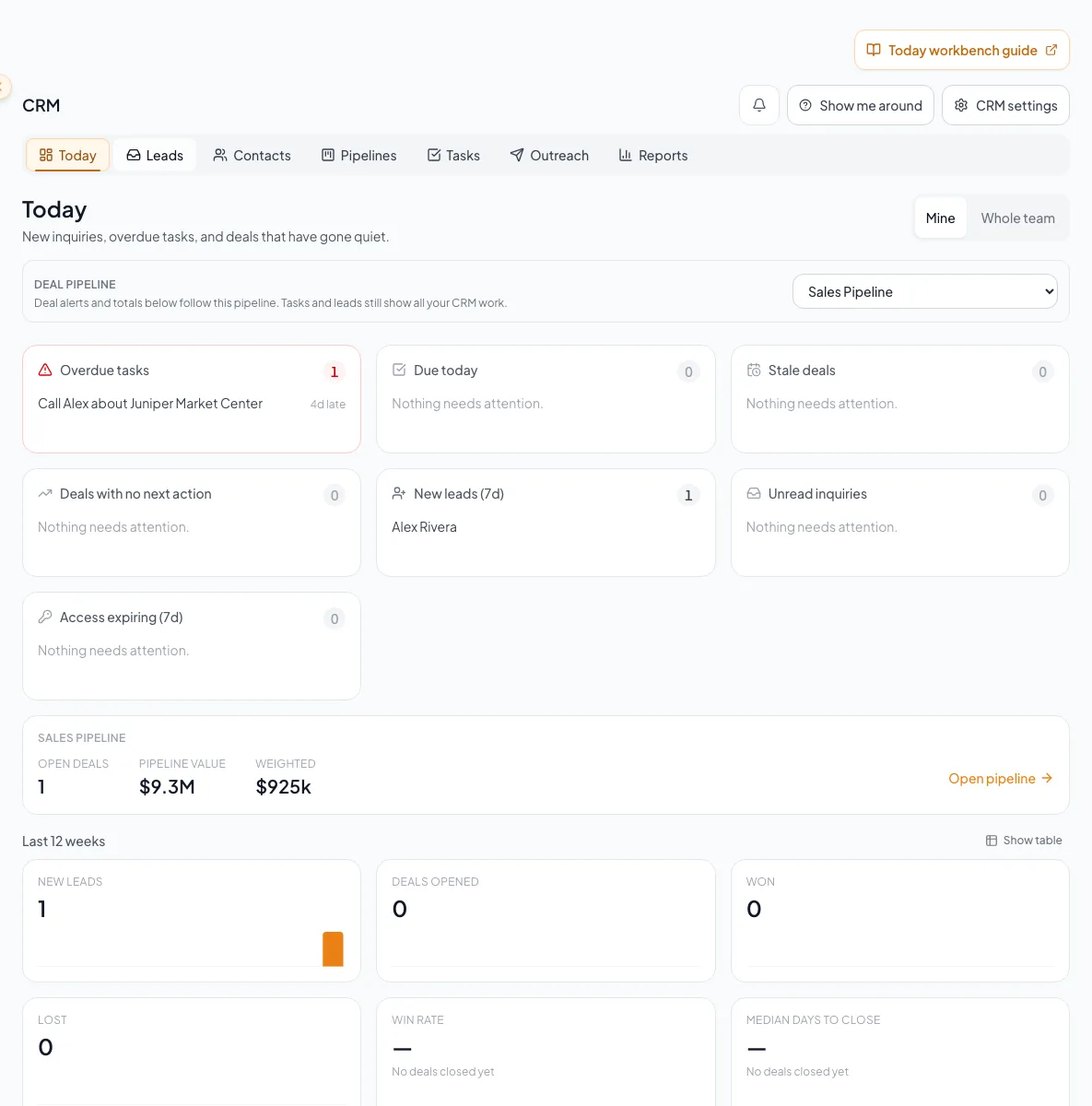
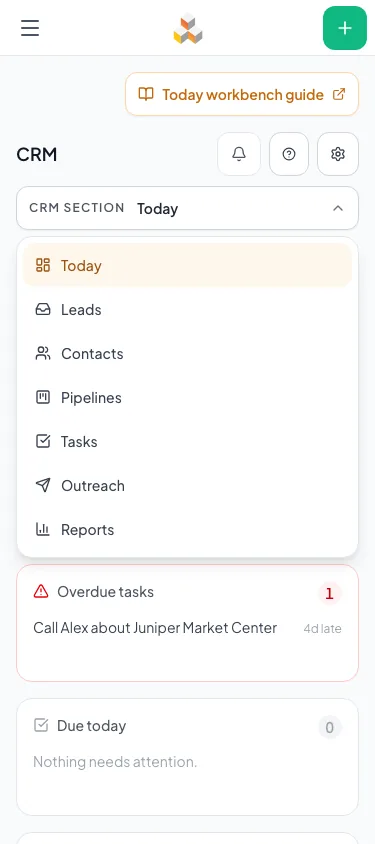
| Area | Use it for | Primary record |
|---|---|---|
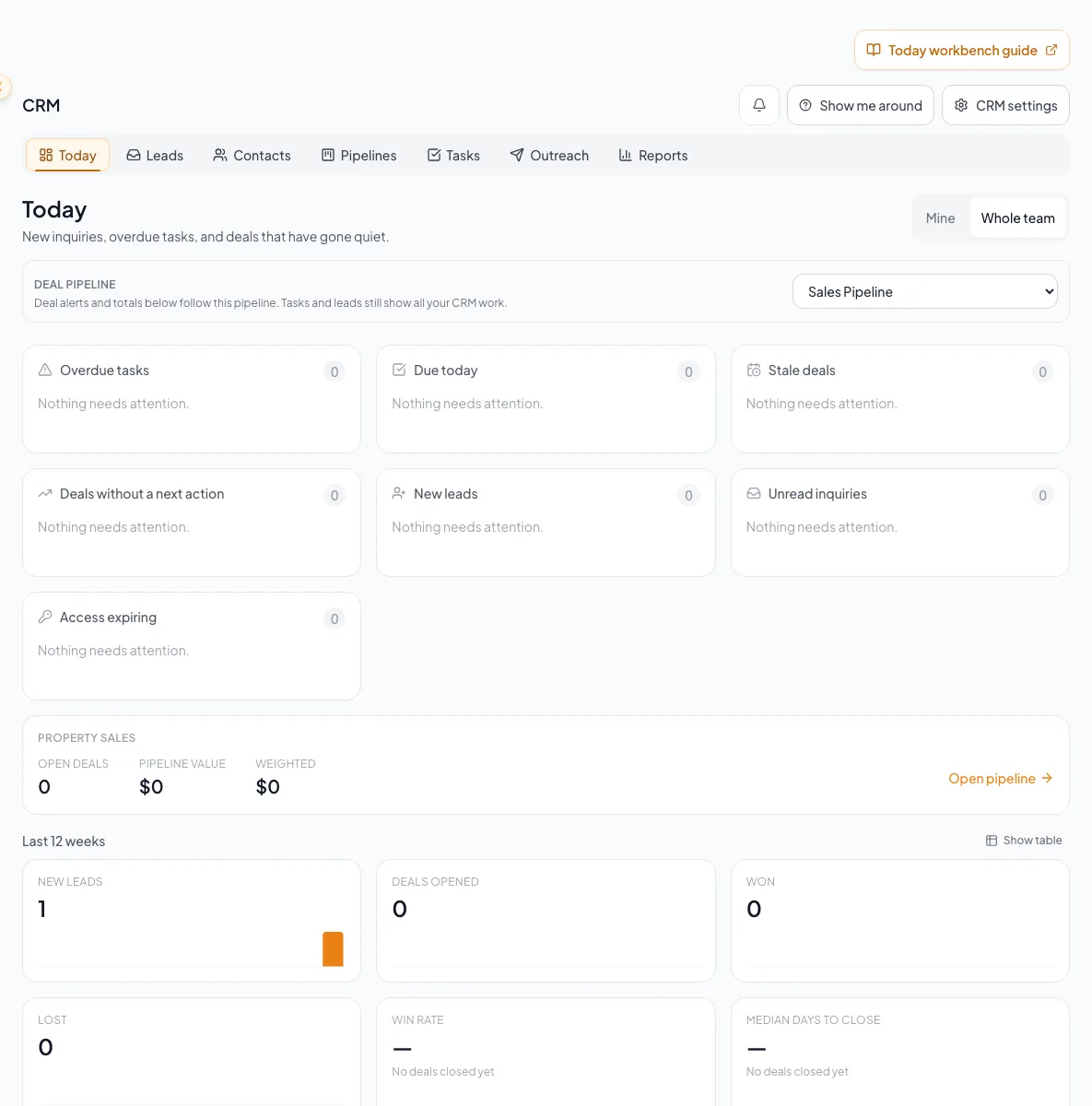
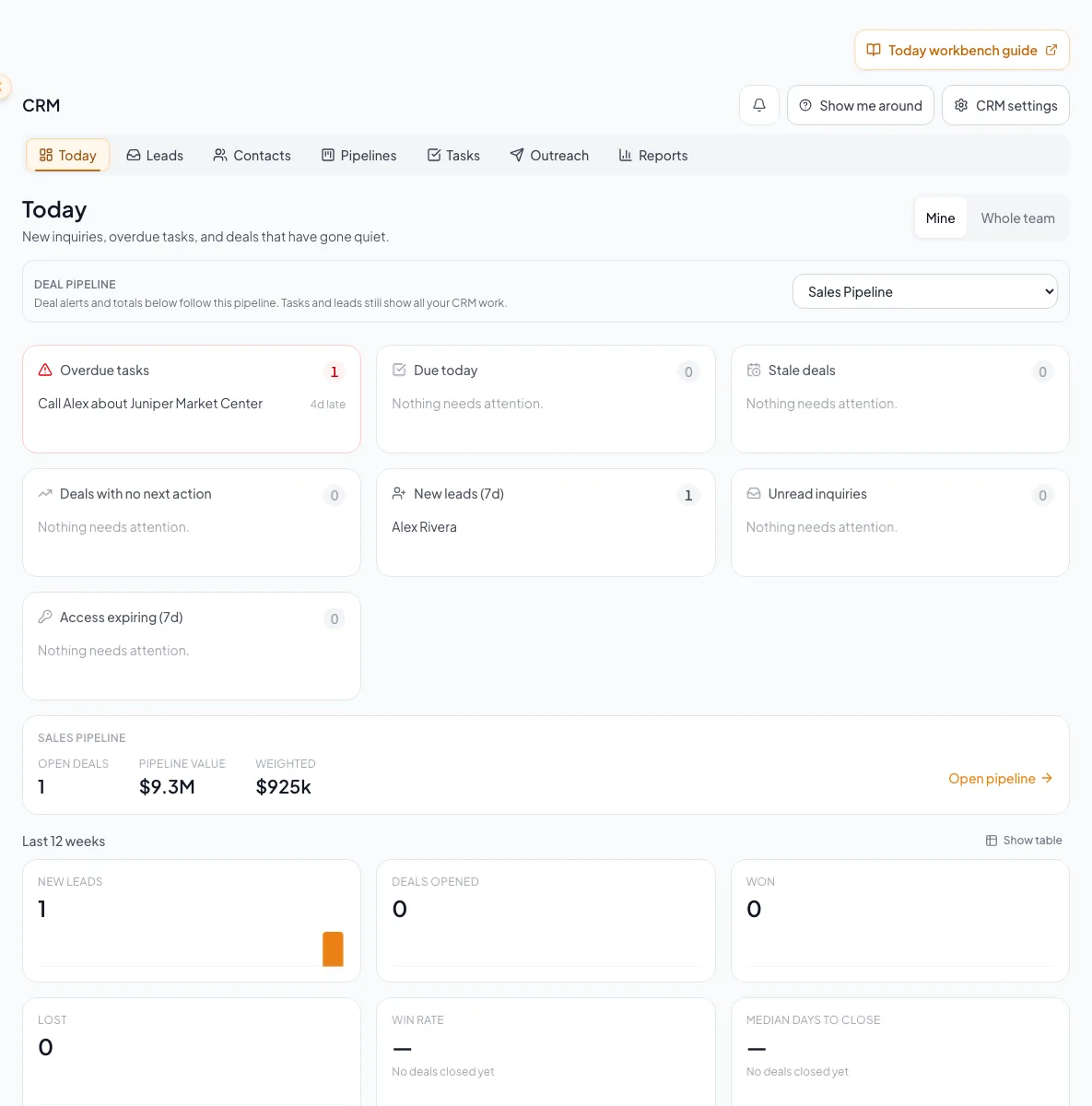
| Today | Prioritized queues and 12-week operating trend | Tasks, leads, deals, and grants |
| Leads | Triage inquiry, NDA, email, forwarded, and manual activity | Activity tied to a person |
| Contacts | People, Companies, requirements, fit, and history | Person or company |
| Pipelines | Deals, Representation opportunities, and Listing progress in Table or Board view | Pipeline record |
| Tasks | Follow-ups and lease-expiration work | Task or current lease |
| Outreach | Team Email Scripts and personal Automations | Script or rule |
| Reports | Pipeline, source, activity, forecast, and performance summaries | Aggregated CRM data |
Complete first-run configuration
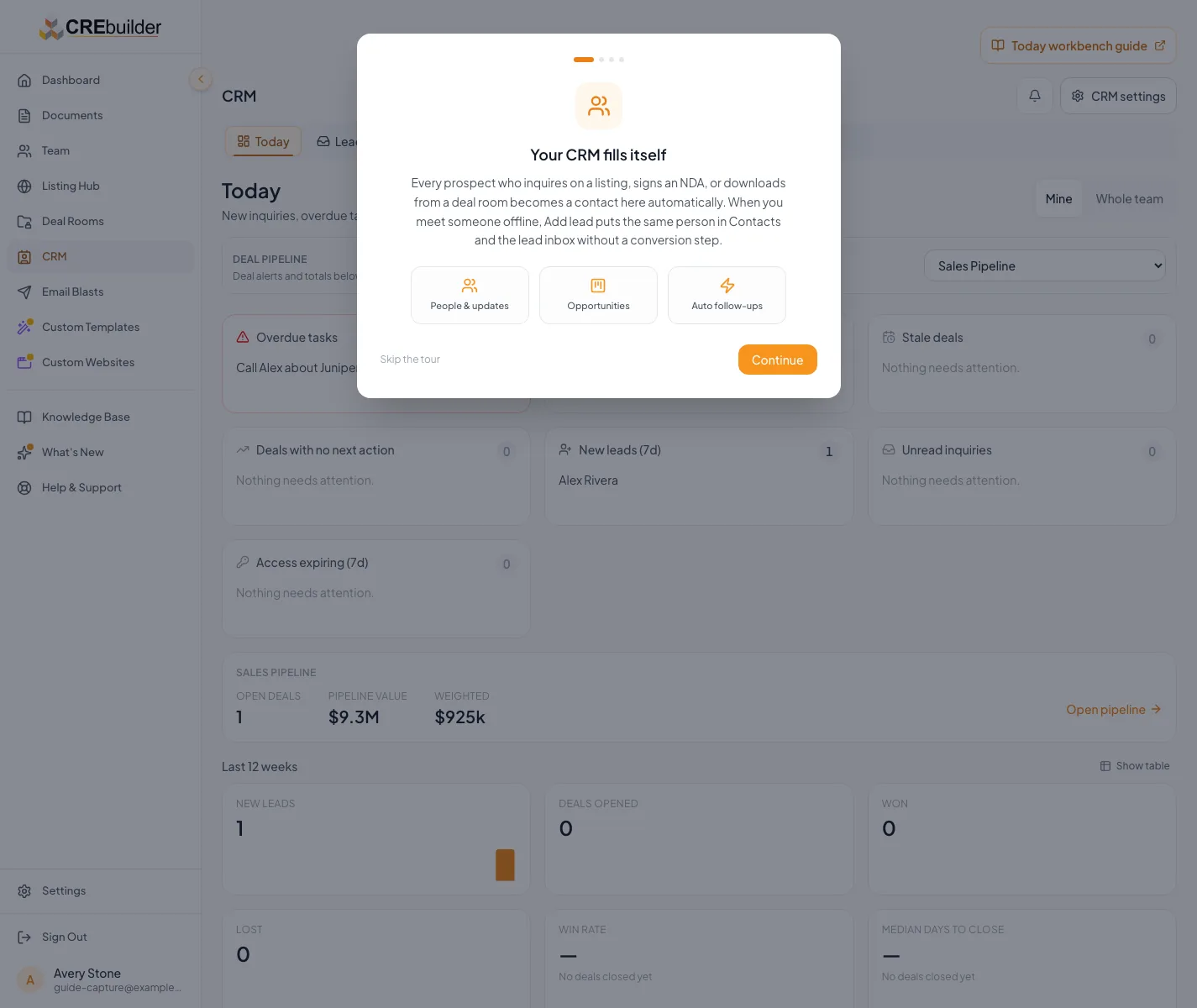
| Setup choice | Who can use it | Effect |
|---|---|---|
| Review capture and Add Lead | All customer CRM roles | Explains how inbound activity and manual entry resolve to canonical People. |
| Add Business Sales | Eligible pipeline administrators | Adds a pipeline beside Property. It never replaces a pipeline or moves existing Deals. |
| Install starter Email Scripts | Authorized team script managers | Adds reusable team content without sending anything. |
| Install suggested task rules | Each user for their own account | Creates personal rules limited to that user’s owned, active contacts. |
| Prepare CREBuilder Mail | Company members subject to access and agreement gates | Enables hosted automation email and NDA invitations only after all readiness checks pass. |
- 1
Confirm CRM access
Main navigation > CRM
Open CRM.
Expected result: Today or the first-run setup experience loads for the current company and role.
If this does not happen: If entitlement is blocked, verify the subscription and company membership before importing or configuring records.
- 2
Review capture and canonical People
CRM setup > Capture
Review the automatic inquiry, NDA, room, manual-entry, and CSV-import examples.
Expected result: The team understands that Leads is activity over People, not a separate database.
If this does not happen: If identity policy is unclear, review the record-model diagram before adding or importing contacts.
- 3
Keep the Property pipeline
CRM setup > Pipelines
Keep Property as the standard pipeline.
Expected result: The Property Deal pipeline remains available and existing Deals remain where they are.
If this does not happen: If Property is missing, ask an eligible pipeline administrator to review the company pipeline configuration.
- 4
Add the optional Business Sales pipeline
CRM setup > Pipelines
If the company handles business transactions and the control is authorized, select Add Business Sales.
Expected result: Business Sales appears as a separate Deal pipeline without moving existing Deals.
If this does not happen: If Business Sales is unavailable, ask an eligible pipeline administrator. Do not create misleading substitute stages.
- 5
Review starter content
CRM setup > Email Scripts and Automations
Compare each starter script and task recipe with the intended workflow.
Expected result: The useful items are identified without creating duplicates.
If this does not happen: If similar content already exists, retain the version that matches current policy.
- 6
Install useful starter content
CRM setup > Email Scripts and Automations
Select Install for each identified starter item.
Expected result: Team scripts and your personal rules appear in their normal CRM pages.
If this does not happen: Remove an accidental duplicate before enabling it.
- 7
Review hosted Mail readiness
CRM setup > CREBuilder Mail
Open Email sending settings when automation email or NDA invitations are required.
Expected result: Settings names the exact access, agreement, business-address, sender, or capacity action still needed.
If this does not happen: Keep hosted email rules disabled until Settings reports ready. Task rules can be configured independently.
- 8
Finish and open Today
CRM setup > Finish
Select Finish.
Expected result: First-run setup closes and the daily workbench opens.
If this does not happen: If a browser completion flag hides the wizard later, use Pipelines, Email Scripts, Automations, and Email sending settings directly.
Set ownership and scope expectations before data entry
Role scope sets the ceiling
Setup choices, filters, and saved views can organize permitted records but cannot expand authorization.
Customer CRM role
Company-wide or own scope
Pipeline, filters, and saved views
Visible and mutable records
- Customer CRM roleCompany-wide or own scopesets ceiling
- Company-wide or own scopePipeline, filters, and saved viewslimits
- Pipeline, filters, and saved viewsVisible and mutable recordsnarrows
Before adding real data
- Name a responsible owner for every imported or manual contact.
- Decide who manages company pipelines and team scripts.
- Explain that automation rules belong to their creator.
- Confirm company address and Mail agreement before hosted outreach.
- Use fictional contacts for the first rule test.
Run the daily sequence
A reliable daily review
- 1
Set Today scope
Main navigation > CRM > Today > scope
Select your permitted scope.
Expected result: The queues reflect Mine or Whole team as selected.
If this does not happen: If the page fails, select Retry. Do not treat an error panel as an empty queue.
- 2
Set the Deal pipeline
CRM > Today > Deal pipeline
Select the applicable Deal pipeline when more than one exists.
Expected result: Deal totals show the chosen pipeline.
If this does not happen: Confirm the company pipeline configuration if an expected choice is absent.
- 3
Open an urgent task
Today > Overdue tasks or Tasks today
Open the next task that requires review.
Expected result: The task context and due state are visible.
If this does not happen: If a teammate is missing from assignment choices, confirm your role and company membership.
- 4
Complete finished work
Open task > Complete
Select Complete only when the task work is finished.
Expected result: The item leaves the active group.
If this does not happen: Reopen or recreate the task according to policy if it was completed accidentally.
- 5
Reschedule unfinished work
Open task > due date
Enter a new due date when follow-up remains.
Expected result: The unfinished task has a clear owner and due time.
If this does not happen: Do not mark unfinished work complete solely to clear Today.
- 6
Open new activity
Today > New leads or Unread inquiries
Open the source event.
Expected result: The source, property context, and canonical person are visible.
If this does not happen: If the same person appears twice, stop and use duplicate merge instead of updating both records.
- 7
Confirm the person
Lead or inquiry activity
Compare the person identity with the source event.
Expected result: The activity is tied to the correct canonical contact.
If this does not happen: Correct or escalate an identity mismatch before adding follow-up.
- 8
Add qualification context
Contact workspace
Add useful tags or requirements.
Expected result: The contact records the relevant interests and qualification context.
If this does not happen: Remove an accidental or unsupported tag before continuing.
- 9
Record the next action
Contact workspace > Updates or Tasks
Create one appropriate next action.
Expected result: The canonical contact timeline contains a useful next step.
If this does not happen: Use a note instead of a pipeline record when the activity is not qualified.
- 10
Advance a real pipeline milestone
CRM > Pipelines
Move a Deal, Assignment, or Listing only when the real-world milestone occurred.
Expected result: The stage and stage age match the actual opportunity.
If this does not happen: To resume a terminal opportunity or listing, choose an active stage and confirm Reopen.
- 11
Add the pipeline next action
Pipeline record > Next action
Enter the immediate next action.
Expected result: The record’s next-action indicator reflects the intended follow-up.
If this does not happen: Create a task when the action also needs an owner and due date.
- 12
Send the external email
Approved external mail client
Send the verified message.
Expected result: The mail client reports its own send outcome.
If this does not happen: Do not mark a draft or copied message as sent.
- 13
Return to the contact
CRM > Contact workspace > Email > Use your email app
Open the same contact’s email activity.
Expected result: The Mark as sent control is available for confirmation.
If this does not happen: Compare the recipient before recording the activity.
- 14
Record the sent email
Contact Email modal > Mark as sent
Select Mark as sent.
Expected result: An email-sent activity appears only after you confirm the real send.
If this does not happen: Close without marking if delivery did not occur.
Respect role scope and recover safely
| Role group | Normal CRM scope | Important limits |
|---|---|---|
| Brokerage Admin, Single Agent, Admin | Company-wide data with Mine and Whole team choices where offered | Internal-only administration is excluded from public workflows. |
| Coordinator, Regular User | Owned records and permitted linked records | Whole-team requests are forced back to own scope. Reading a linked contact does not grant mutation rights. |
Common orientation problems
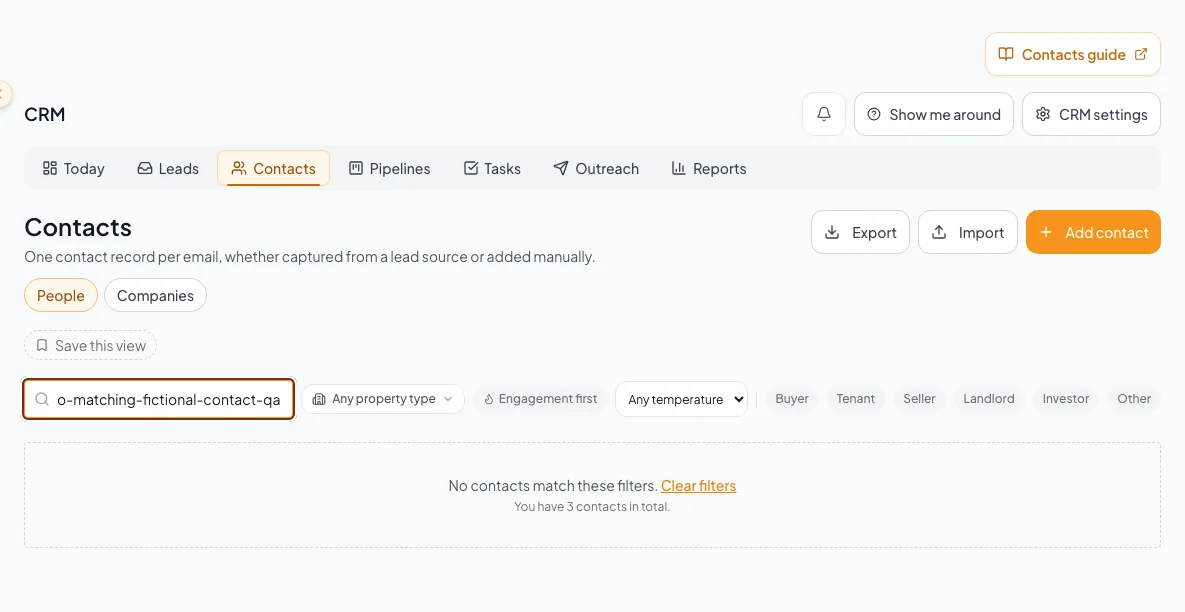
A queue or report looks empty
Likely cause: The selected scope, pipeline, or filter may exclude the expected record.
- Confirm Mine versus Whole team.
- Confirm the selected Deal pipeline.
- Open the destination page and clear filters.
- If an error is shown, use Retry before concluding that no records exist.
You can open a record but cannot edit it
Likely cause: Own-scoped users can sometimes read a contact through an owned deal without owning the contact.
- Check the displayed owner.
- Ask an authorized teammate to transfer ownership or make the change.
- Do not create a duplicate to bypass the permission.
Business Sales is not offered during setup
Likely cause: The current user lacks pipeline administration authority, or the pipeline already exists.
- Check the Deal pipeline selector.
- Ask an eligible pipeline administrator.
- A lone active Regular User can have a narrow exception, while Coordinators cannot administer pipelines.
A starter email rule cannot run
Likely cause: Hosted contact-email actions require approved CREBuilder Mail, the current agreement, a complete company address, and all send gates.
- Open Settings > Email sending.
- Complete the displayed readiness actions.
- Re-enable the rule only after Mail is ready.
Final verification
- Pipeline record > Next action: The record’s next-action indicator reflects the intended follow-up.
- Approved external mail client: The mail client reports its own send outcome.
- CRM > Contact workspace > Email > Use your email app: The Mark as sent control is available for confirmation.
- Contact Email modal > Mark as sent: An email-sent activity appears only after you confirm the real send.
- No blocking warning, failed status, or unresolved validation message remains in the completed workflow.