Outcome
You will enter reliable structured data, understand where it is reused, and correct source content without masking the problem in the final design.
Navigation path
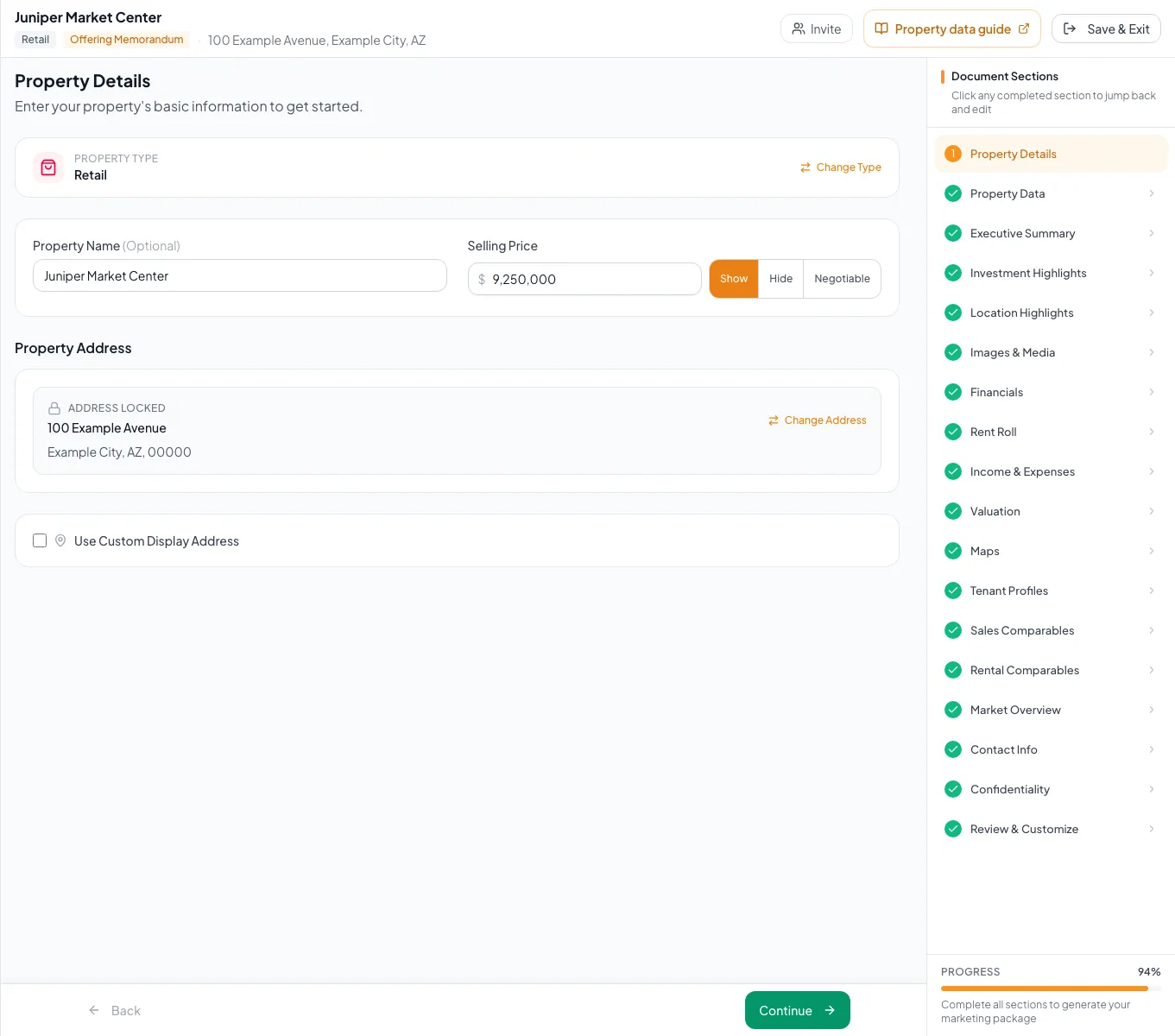
Documents > Open document > Document Wizard
Access
Editing requires access to the document. Visible sections depend on package, property type, template, and role.
On this page
What you will accomplish
Goals
- Find the source section for a value
- Enter structured fields with the correct units
- Confirm saved data in Review & Customize
Edit the source, then verify the output
Structured facts flow from their owning wizard section into every generated page that uses them.
Verified source
Confirm the fact and unit
Owning wizard field
Change the source value once
Saved state
Wait for confirmation
Review output
Check every downstream use
- Verified sourceOwning wizard field
- Owning wizard fieldSaved state
- Saved stateReview output
Before you start
Data, sources, and access to prepare
- Access to the document
- A verified source for the information being entered
Prepare these details
- Identify the exact fact or section to change
- Confirm its source and unit
- Know whether the change applies to one building or the whole document
Complete the task
- 1
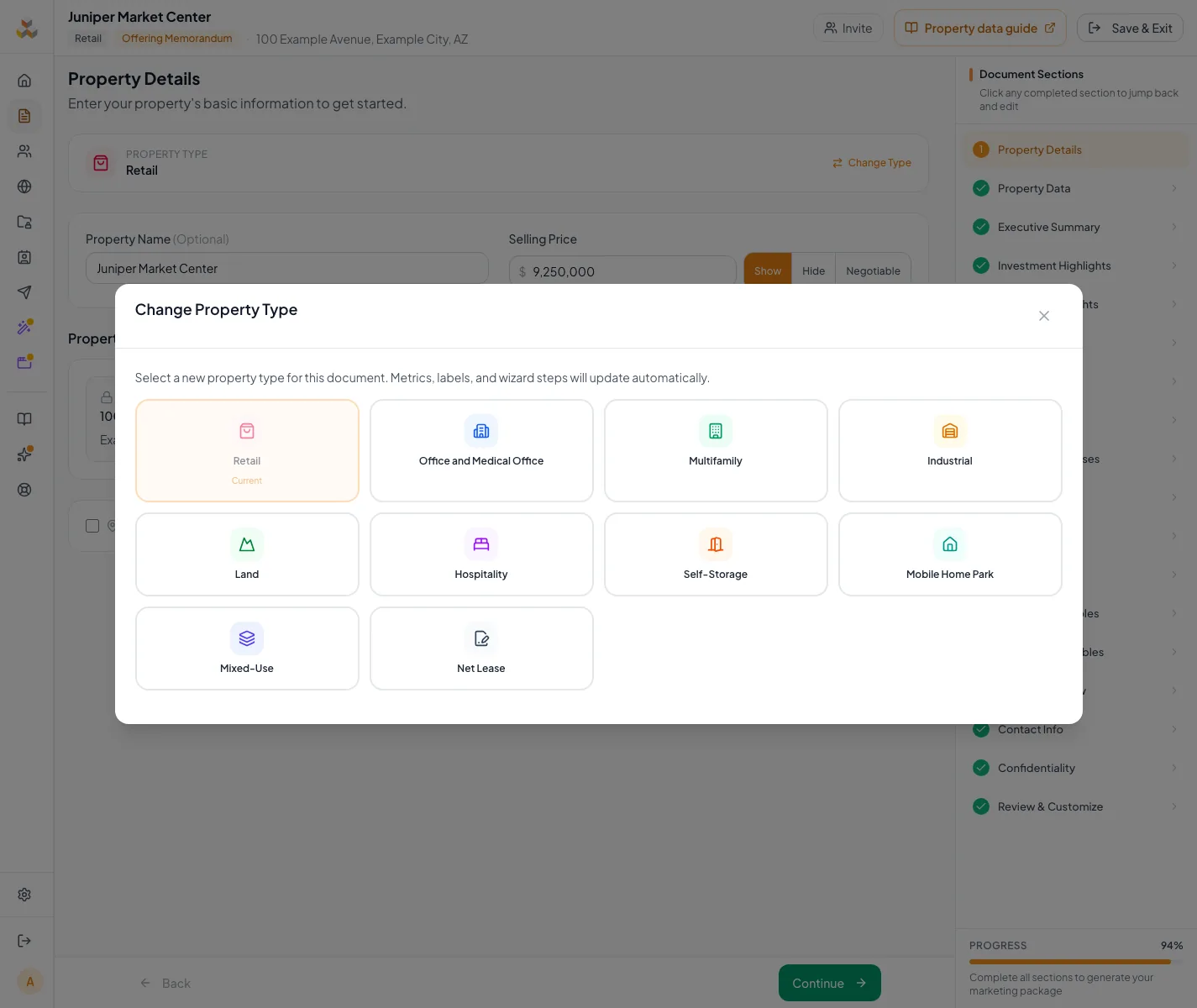
Open the document
Documents
Select the intended document row.
Expected result: The document wizard opens with the saved draft.
If this does not happen: Compare the property address and package before editing if similarly named documents exist.
- 2
Open the source section
Document Wizard navigation
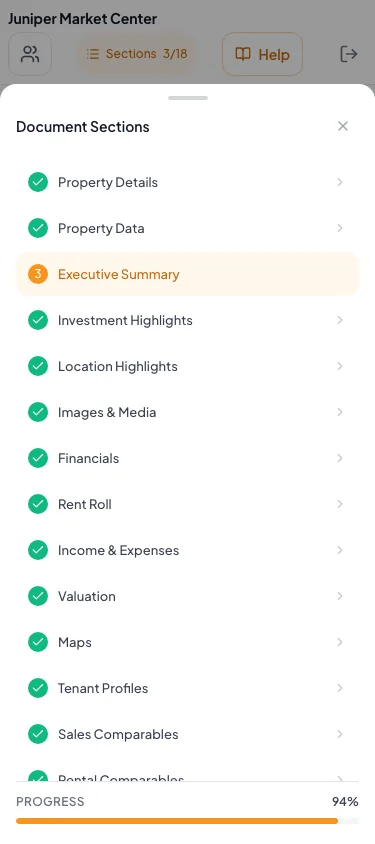
Select the section that owns the value from Document Sections or the Sections drawer.
Expected result: The relevant form or editor appears with the same document progress.
If this does not happen: Use Review & Customize to identify the source section when the final page name differs.
- 3
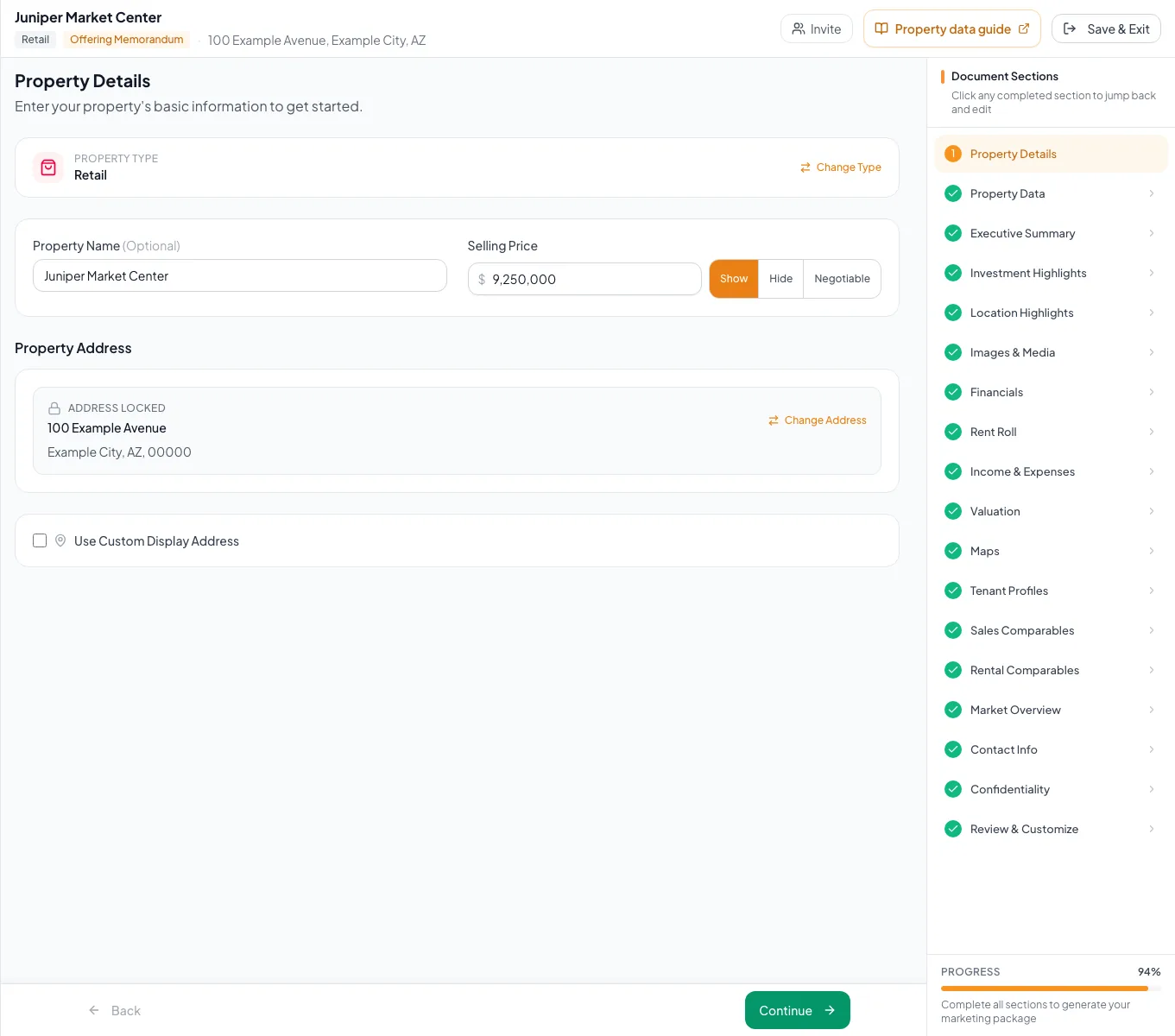
Edit one field
Selected wizard section
Change the one field supported by the verified source.
Expected result: The field shows the new value and any calculation updates.
If this does not happen: Restore the prior value if the unit, meaning, or source is uncertain.
- 4
Resolve displayed validation
Selected wizard section
Correct the field named by the validation message.
Expected result: The validation message clears.
If this does not happen: Check the required format and property-type behavior in the field reference.
- 5
Confirm the save state
Wizard header
Wait until the save indicator reports completion.
Expected result: The section is stored before navigation.
If this does not happen: Keep the entered values on screen and use Retry save if saving fails.
- 6
Inspect the output
Review & Customize
Open the page that uses the edited value.
Expected result: The assembled page reflects the saved source data.
If this does not happen: Return to the owning wizard section instead of typing over generated output.
Common structured fields
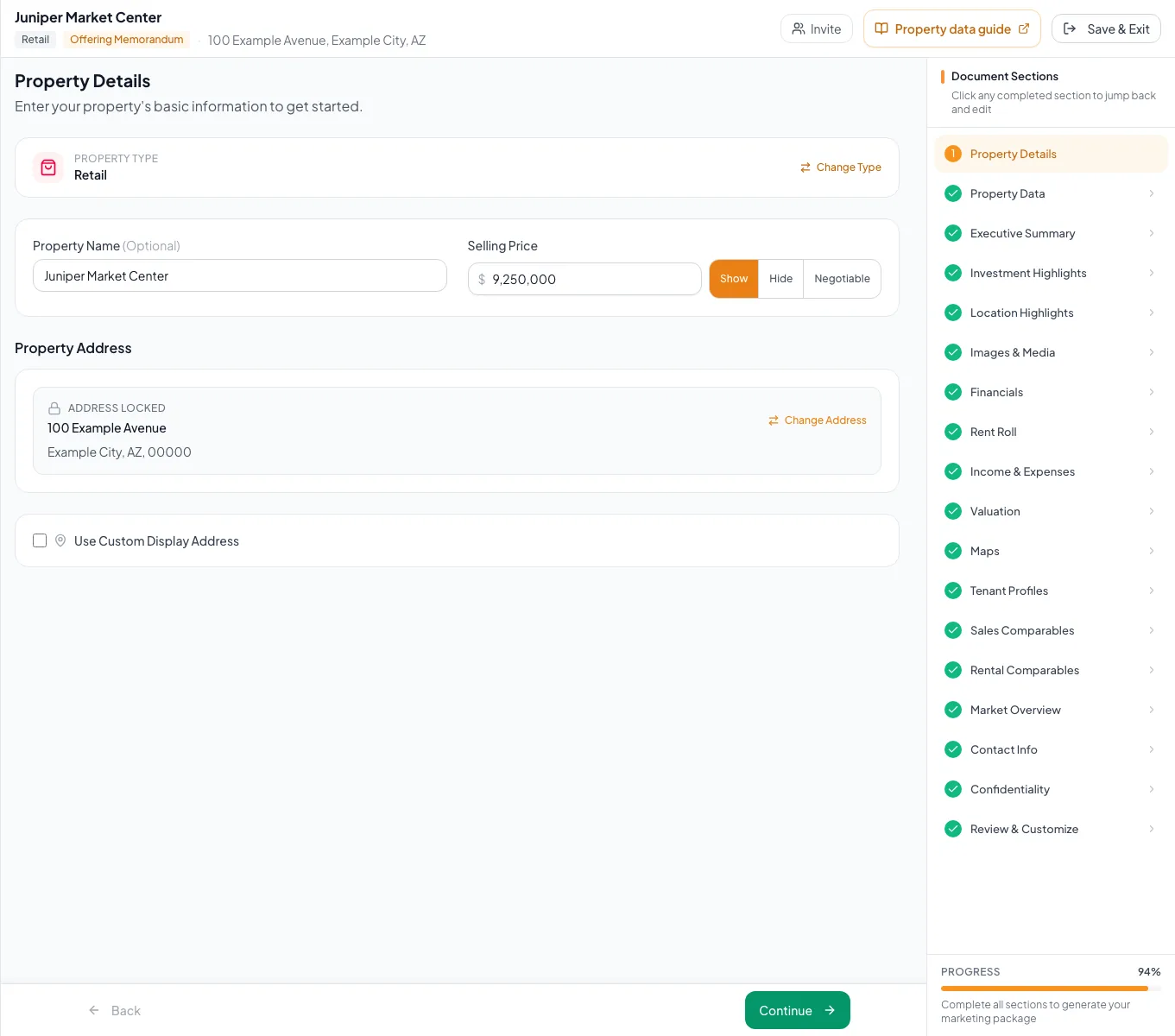
On wide screens, Document Sections stays beside the editor. On smaller screens, select Sections to open the same navigation and see the current step count. Available sections still depend on document type, property type, template and financial scope.
Desktop Document preview opens by default and remembers Show preview or Hide preview. On tablets and phones, select Preview to open it when needed. Closing a preview or helper drawer leaves the draft in place. Use the main page scroll to reach lower fields; wide tables keep their own horizontal scroll.
Verify meaning and units before entry
| Field | Requirement | What it means | Format | Units | Save behavior | Downstream effect |
|---|---|---|---|---|---|---|
| Property name | Required | The marketed name used across headings and public experiences | Plain text | Not applicable | Follow the owning Property Details save state and remain on the section until it confirms completion. | Changing it can affect multiple pages and public property identity. |
| Address | Required | The subject location used for identity and geocoding | Search-selected geocoded address | Not applicable | Select the exact address result and wait for the owning Property Details save state to complete. | Changing it can affect maps, demographics, and listing identity. |
| Building area | Recommended | The property area in the unit shown by the selected property type | Numeric value in the displayed property-type field | Use the area unit printed beside the field | Wait for the owning property-data section to report a completed save before navigating. | Can feed price, area, and occupancy metrics. |
| Price or lease terms | Optional | The transaction terms appropriate to the selected package | Currency or rate value in the displayed field format | Use the currency or rent basis printed beside the field | Wait for the owning transaction section to report a completed save before reviewing output. | May appear on document summaries and public listings. |
| Calculated metrics | Calculated | Values CREBuilder derives from source fields | Not applicable | Not applicable | No direct entry. The metric automatically recalculates after its price, area, rent, unit-count, or NOI source fields save. | Generated document and listing metrics use the recalculated result; correct the inputs rather than the display. |
Required means the field is needed to complete or support this workflow. Some screens allow a draft to save before every required item is complete. The steps and troubleshooting call out controls the product actively blocks.
Verify before you finish
- The correct document and building were edited
- Units match the field label
- The save state completed
- Review & Customize shows the expected value
- Related totals or narrative remain consistent
Troubleshooting and next steps
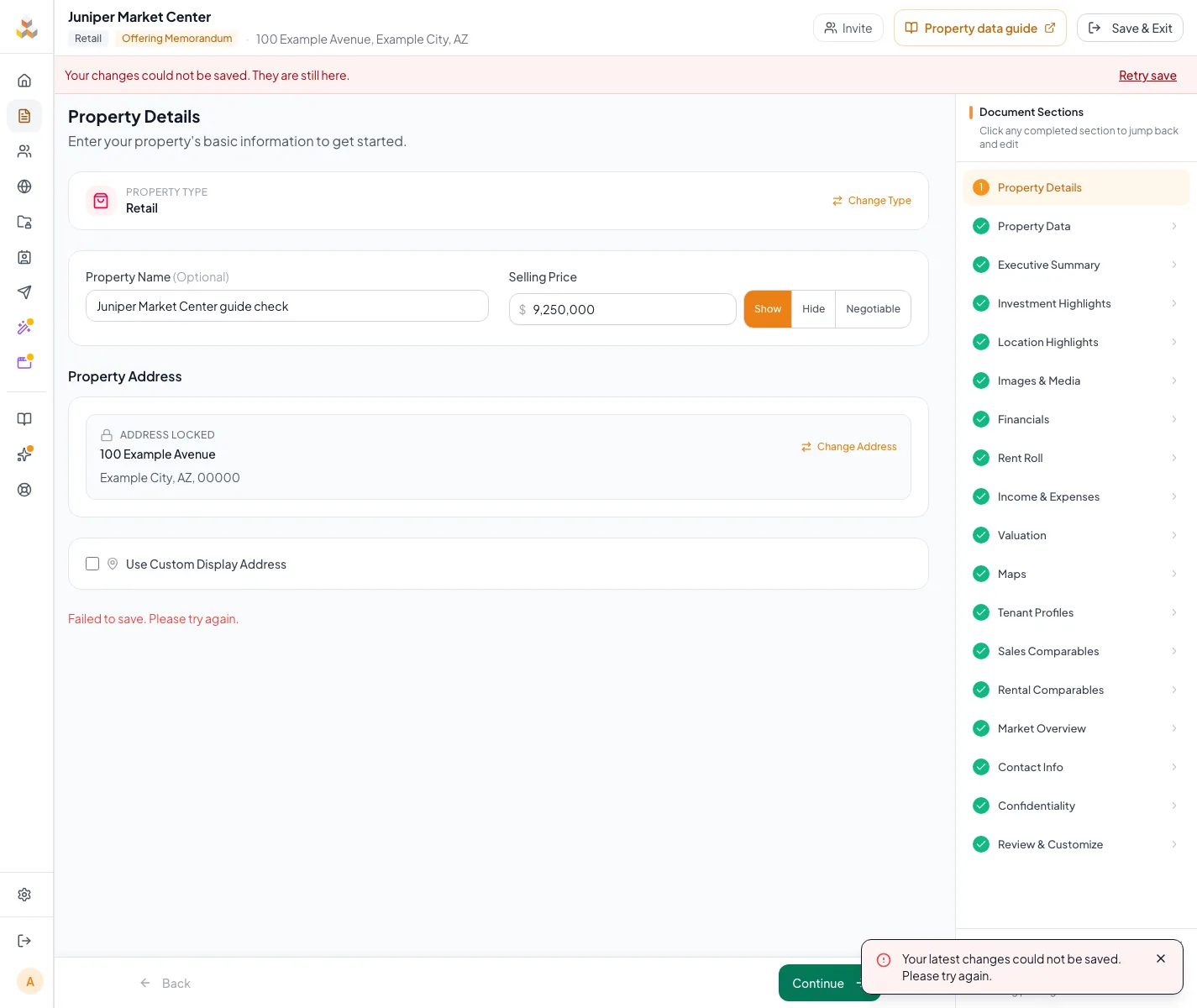
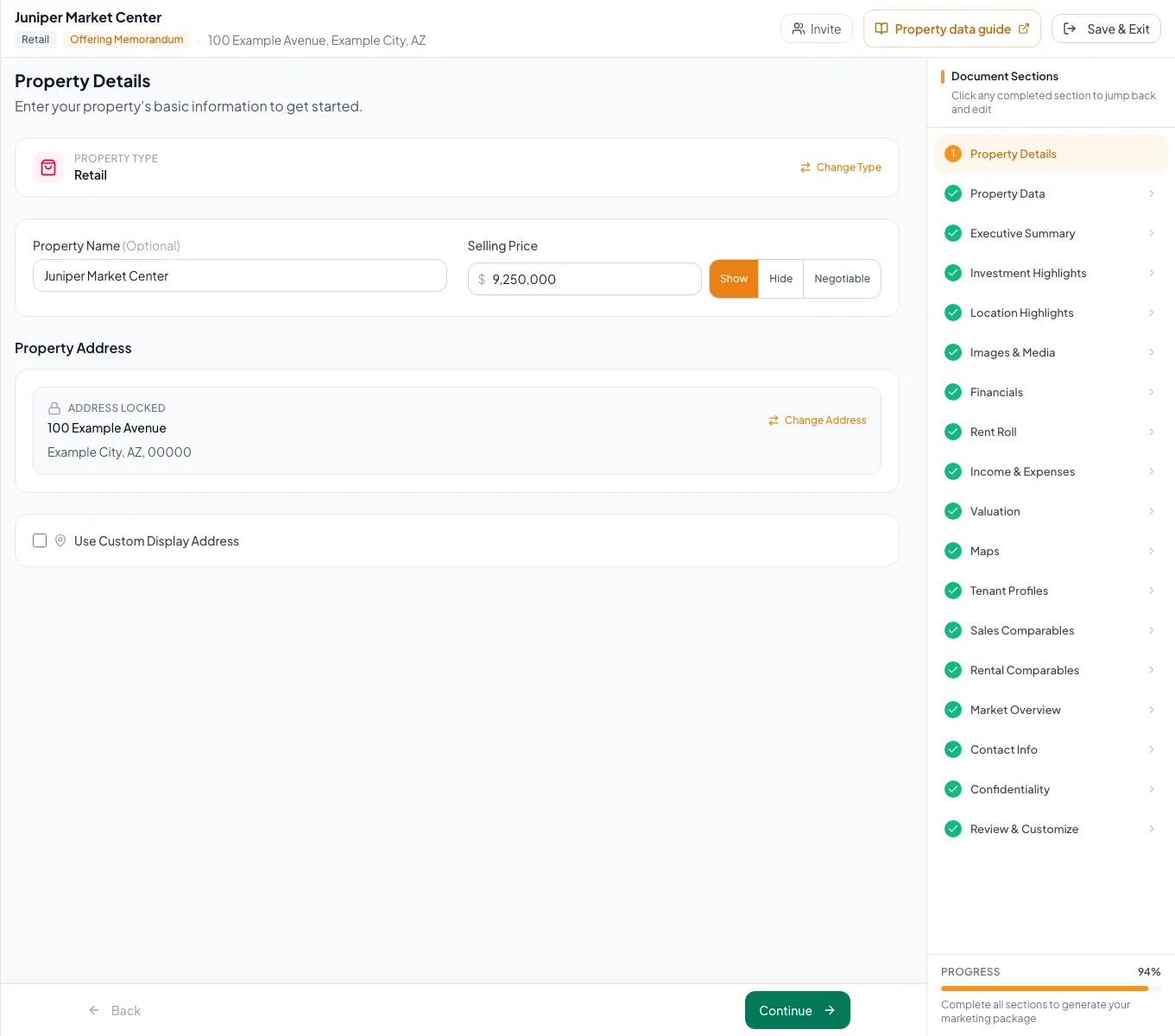
A value returns after it is changed.
Likely cause: The edited display may be calculated or sourced from another wizard section.
- Identify the owning source section.
- Change the source input and wait for the save state.
A section shown in another guide is absent.
Likely cause: Wizard sections vary by package, property type, template, and scope.
- Confirm the current document setup.
- Follow only the sections displayed for this document.
Final verification
- Selected wizard section: The field shows the new value and any calculation updates.
- Selected wizard section: The validation message clears.
- Wizard header: The section is stored before navigation.
- Review & Customize: The assembled page reflects the saved source data.
- No blocking warning, failed status, or unresolved validation message remains in the completed workflow.