Outcome
Every building or parcel has complete, correctly owned physical data without unintended orphan or deleted records.
Navigation path
Document wizard > Buildings & Properties > Property Details > Property Data
Access
A multi-property document
On this page
Before you start
Data, sources, and access to prepare
- A saved list of building or parcel records
- Verified facts for each record
Keep ownership explicit
Building data ownership
The document contains records, and each record owns its own physical and financial details.
Document
Shared portfolio or campus context
Building Record
Name, type, address, coordinates
Property Data
Flexible label and value rows
Linked Financial Rows
Tenants, vacancies, income, expenses
Building Sections
Correct facts under the correct name
- DocumentBuilding Record
- Building RecordProperty Data
- Building RecordLinked Financial Rows
- Property DataBuilding Sections
- Linked Financial RowsBuilding Sections
| Data | Location | Scope |
|---|---|---|
| Name, type, address | Buildings & Properties card | One building or parcel |
| Flexible facts | Property Data building accordion | One building or parcel |
| Shared document narrative | Other wizard narrative steps | Whole document unless the page offers building sections |
| Tenant and vacancy rows | Multi-property Rent Roll accordion | Selected building |
| Income and expense rows | Multi-property Income & Expenses accordion | Selected building or legacy portfolio-wide pool |
Complete each property record
| Field | Requirement | What it means | Format | Units | Save behavior | Downstream effect |
|---|---|---|---|---|---|---|
| Name | Required | Building Name for most records or Parcel Name for a Land record. | Plain text | Not applicable | Typing triggers a per-building 400 ms debounced save; verify the collapsed card retains the value. | Names the record in card headers, per-building data areas, financial accordions, and final sections. |
| Property Type | Recommended | Individual asset type for the record. | Select one supported property type | Not applicable | The building update saves after the selection change through the per-field 400 ms debounce. | Controls labels, suggested facts, and financial editor behavior for that building without changing other records. |
| Address | Recommended | Search-selected location. | Select a verified address or parcel-search result | Postal address | Selecting a result saves its address components and any successful geocode together for the selected record. | Populates the record location and coordinates used by maps and demographics. |
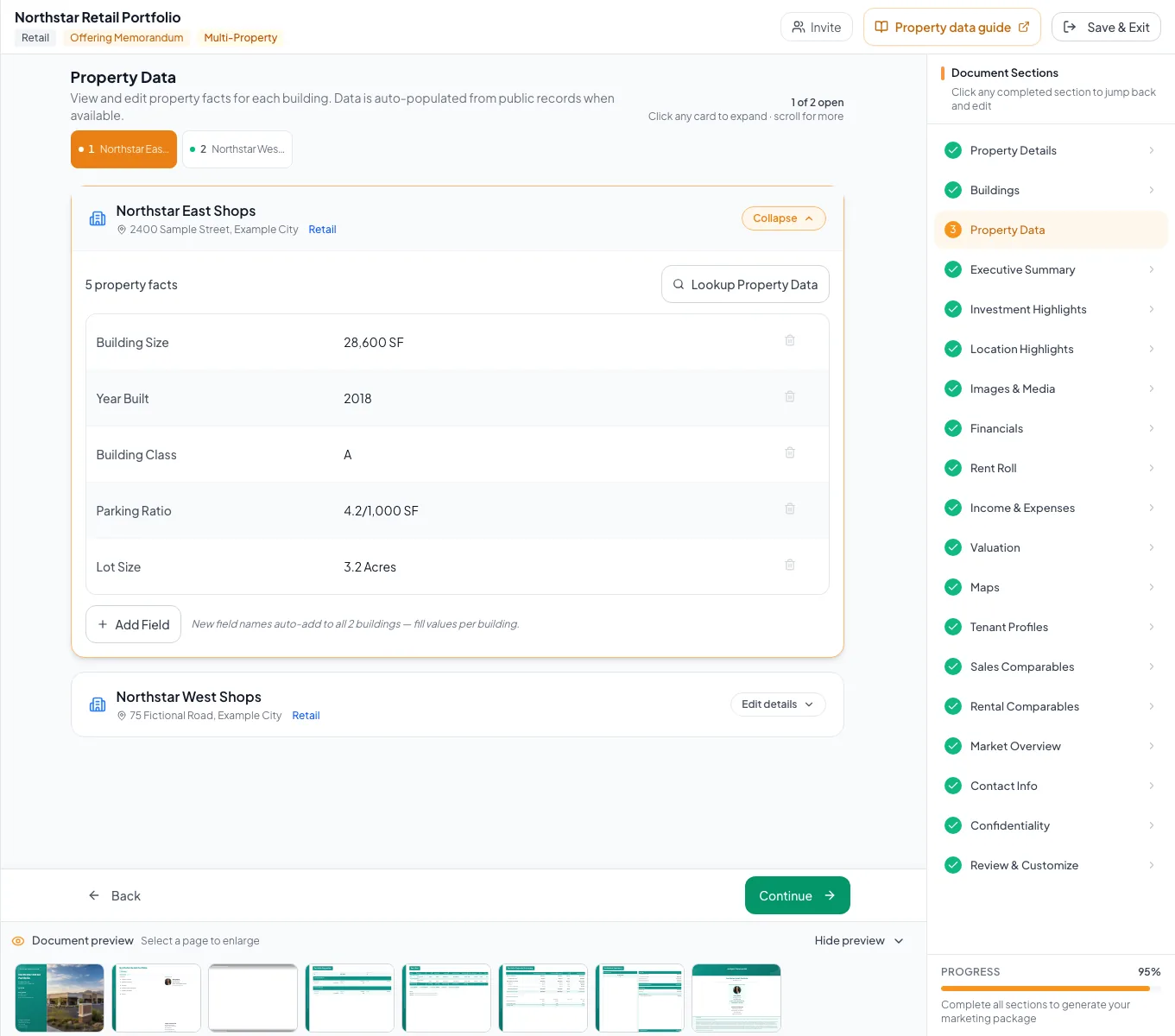
| Property Data Rows | Recommended | Editable label and value pairs such as Building SF, units, acreage, year built, or zoning. | Plain-text label with a source-formatted value | Use the unit named by each row label | Each add, edit, delete, or reorder starts a save for that building Property Data collection. | Displays facts under the selected building section and keeps them separate from sibling-building data. |
| Sequence | Recommended | Order of cards and final building sections. | Drag or keyboard-defined list position | Ordinal position | A reorder action saves the full ordered building-ID list; a failed request rolls the visible order back. | Controls card order and the sequence of generated building or parcel sections. |
Required means the field is needed to complete or support this workflow. Some screens allow a draft to save before every required item is complete. The steps and troubleshooting call out controls the product actively blocks.
Deletion cascades
Deleting a building permanently deletes its linked tenants, vacancies, expense items, and additional-income items. The confirmation lists counts. This action cannot be undone.
Enter and verify per-building data
Building-data steps
- 1
Open the building card
Buildings & Properties
Expand the intended record.
Expected result: The record fields are visible for review.
If this does not happen: Compare the card header with your source if the wrong record opens.
- 2
Verify the building identity
Expanded building card
Compare the name, type, and address with the approved source.
Expected result: The correct identity appears in the card header.
If this does not happen: Correct the record before adding downstream data if any field is wrong.
- 3
Search for the address
Expanded card, Address
Enter the exact address or parcel search terms.
Expected result: Matching address or parcel results appear.
If this does not happen: Use Search by Parcel when address search cannot identify Land.
- 4
Select the valid address
Expanded card, Address results
Select the exact address or parcel result.
Expected result: Street, city, state, ZIP, latitude, and longitude are saved.
If this does not happen: Clear the selection and search again if the coordinates or address are wrong.
- 5
Open the building data accordion
Property Data
Expand the building or parcel whose facts you are entering.
Expected result: Its current data rows and available fields appear.
If this does not happen: Compare the accordion name with your source before editing.
- 6
Add a fact field
Building Property Data table > Add field
Add one suggested or custom field needed by the source.
Expected result: A labeled row appears in the intended building table.
If this does not happen: Delete an accidental empty row before adding a replacement.
- 7
Enter the fact value
Building Property Data table > value
Enter the source-verified value in the new row.
Expected result: The property table contains the known fact.
If this does not happen: Confirm the unit and building before entering the value.
- 8
Order the fact rows
Building Property Data table > reorder controls
Move one row to its intended reader-priority position.
Expected result: The fact table follows the planned reading order.
If this does not happen: Correct accidental duplicate labels before reordering.
- 9
Complete the remaining records
Property Data building list
Enter the available source facts for each remaining record.
Expected result: Every record has comparable source coverage.
If this does not happen: Do not copy a value across buildings unless the source confirms it applies to each.
- 10
Cross-check shared fields
Property Data building list
Compare shared fields such as SF, units, year, or acreage across the completed records.
Expected result: Unexpected differences are identified for source review.
If this does not happen: Resolve a discrepancy against the source instead of forcing values to match.
- 11
Review generated sections
Review & Customize
Compare each building or property section with its source record.
Expected result: No building displays another building’s facts.
If this does not happen: Return to the matching accordion for corrections.
Protect building-level data
A building is missing from maps or demographics
Likely cause: Coordinates are blank even if text address exists.
- Search and select the address again.
- Use parcel search for Land.
- Confirm the page warning clears.
A row appears under the wrong building
Likely cause: The wrong accordion or building selector was active during entry.
- Record the correct source value.
- Edit the correct building record.
- Remove or correct the misplaced row intentionally.
Removing a building will delete linked records
Likely cause: Building deletion is a permanent cascade.
- Read the confirmation counts.
- Cancel and preserve or relocate source data first.
- Delete only when the entire record and its linked data should be removed.
Building data approved
- Names unique and reader-friendly
- Types accurate
- Addresses geocoded
- Physical facts sourced
- No empty or duplicate rows
- No data under the wrong record
Related guides
Build a multi-building or portfolio document
Choose the right multiple-property structure, add every building or parcel, assign property types, and establish a reliable document order.
Open guideBuild multi-property rent rolls and financials
Enter rent roll, additional income, and expenses by building, then reconcile portfolio totals and legacy portfolio-wide rows.
Open guideReview multi-property document output
Verify campus, assemblage, and portfolio labels, combined rent rolls, financial summaries, pagination, maps, and orphan-data handling.
Open guide