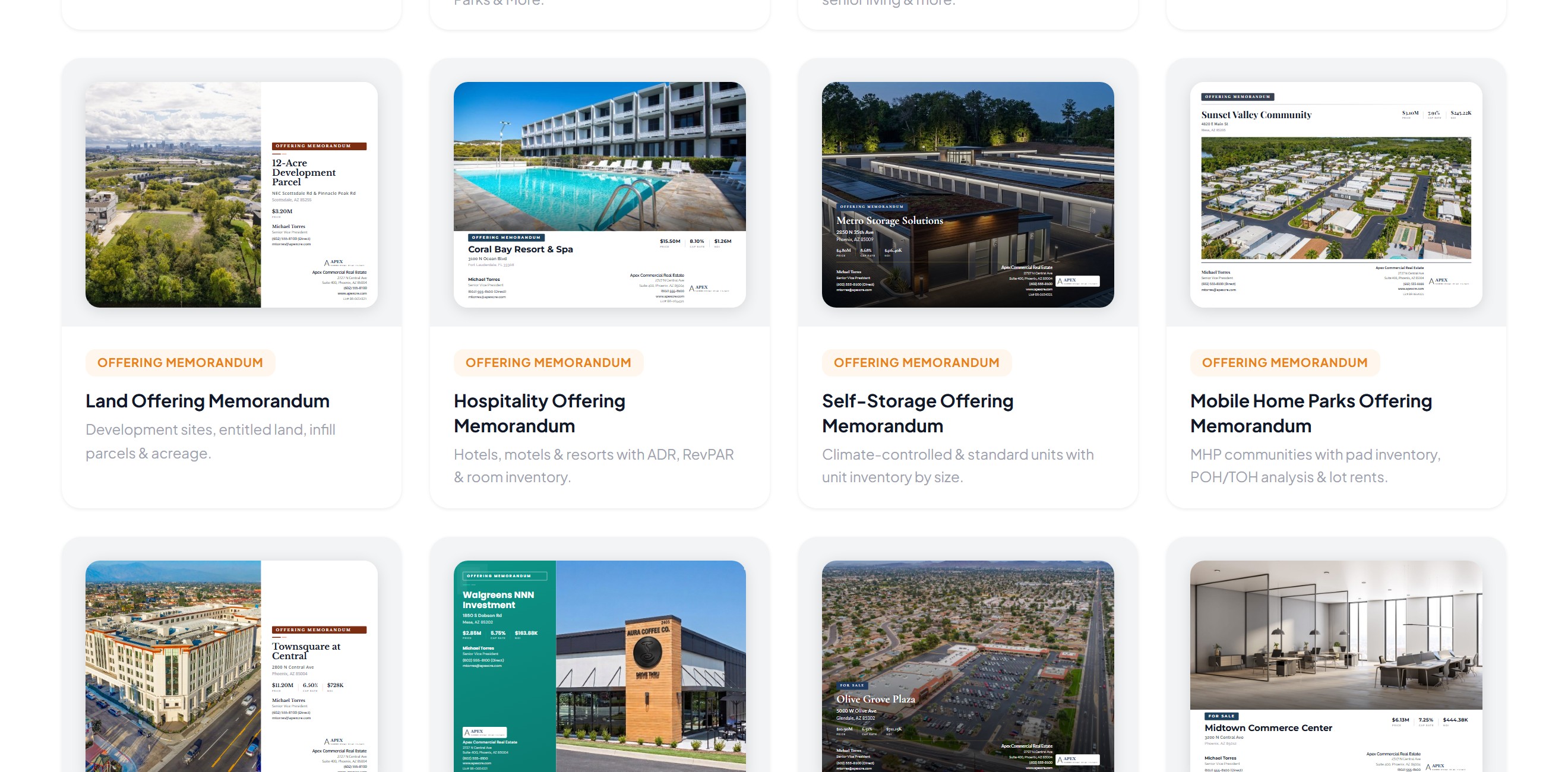
Commercial real estate marketing software is how modern brokers produce the documents that move deals — offering memorandums, sales teasers, leasing packages, flyers, and property listing pages — without losing a full day to InDesign, Canva, or a third-party designer.
If you're still piecing marketing materials together from Word templates and copy-pasted tax data, you're doing the same work other brokers finished in 30 minutes this morning. This guide walks through what CRE marketing software actually does, the features that matter, how it's priced, and how to pick the right platform for the way you run deals.
What commercial real estate marketing software is (and what it isn't)
CRE marketing software is a purpose-built tool for commercial brokers to create branded marketing documents and listing pages for their deals. It isn't a CRM, a listing exchange, a comps database, or a design tool — although the better platforms pull data from each of those categories so you don't have to.
A modern CRE marketing platform replaces three things brokers used to cobble together:
- A designer or design tool (InDesign, Canva, a VA) — for layout and branding.
- A data lookup (county records, CoStar, tax parcels) — for property facts.
- A financial modeling step (Excel, calculator) — for rent roll, NOI, cap rate, and pro forma.
Good software collapses all three into a single address-in, PDF-out workflow. You enter a property address, the platform auto-fills the basics (ownership, lot size, year built, tax value, tenant data where available), you fill in the deal-specific fields, and it produces a branded OM or flyer without a layout pass.
Why brokers need CRE marketing software now
The bar for CRE marketing materials has quietly gone up. Investors — especially the family offices, 1031 buyers, and out-of-market groups that make up an increasing share of deal flow — expect institutional-quality packages on every listing, not just the eight-figure ones.
That shift hurts in three specific ways if you're still DIY'ing:
- Speed to market. The broker who gets a polished OM in front of qualified buyers on day one of exclusivity wins more deals than the broker whose OM takes five business days to produce.
- Presentation consistency. When every OM in your pipeline looks different because three associates each Frankenstein'd their own Word template, your brokerage looks smaller than it is.
- Broker time. An experienced broker billing a full commission shouldn't be spending four hours formatting rent rolls. The opportunity cost of manual document production is higher than any realistic software subscription.
The shift isn't hypothetical. Offering memorandum template searches have gone up year over year; brokers are actively looking for a faster way to produce them.
What CRE marketing software does — the 7 core capabilities
Not all platforms offer all of these, and the gaps matter. Here's what to expect from a complete solution:
1. Auto-populated property data
The platform should pull ownership, parcel, tax, building, and (for multi-tenant) tenant data from a nationwide property database when you enter an address. Look for coverage of all 50 states and at least 100M+ property records. If you're still typing in the lot size by hand, the platform isn't doing its job.
2. Professional document templates
You want multiple templates per document type (not one "OM template" — at least a handful, ideally varied enough to match asset classes from retail strip centers to Class A office). Templates should be editable — colors, fonts, branding, photos — without having to open a design tool.
3. A built-in financial calculator
The financial section is where OMs live or die. Your platform should handle rent roll entry, expense schedules, cash flow projections, NOI calculations, cap rate and valuation, pro forma analysis, and exit assumptions. If you're exporting to Excel and pasting back in, you haven't escaped spreadsheets — you've just added a step.
See: CREBuilder's financial calculator for what a built-in model looks like.
4. Maps and aerials
Every OM needs a location map, an aerial with labeled comps or demographics, and a regional context shot. CRE platforms handle Google-style maps with editable pushpins, aerial map builders with logo overlays and shape annotations, and demographic radius maps. Manually pasting screenshots of Google Maps is a red flag for buyers; a purpose-built map builder is table stakes.
5. Demographics and market data
Population, household income, median age, population growth, retail spending — for 1, 3, and 5 mile rings, plus trade area commentary. Esri is the common data source; confirm the platform can pull demographics automatically for any U.S. address.
6. PDF export + digital sharing
Print-ready PDF is still the backbone of CRE marketing. But buyers increasingly want to view on mobile, share via link, and skim before they download. The better platforms give you a shareable web version of every document alongside the PDF, so you can send a single link to a buyer list instead of a 40MB attachment.
7. Listing pages and public property sites
This is the fastest-growing part of CRE marketing software. A commercial property listing page gives each active deal its own URL — photo gallery, map, financials, documents, broker contact — without you needing to touch a website CMS. It's the modern equivalent of a "property website" product, but synced to the same data as your OM so there's no duplication.
What documents CRE marketing software produces
The document mix varies by platform, but a complete solution should cover:
- Offering Memorandum (OM) — the 20-50 page investment sales package. Still the most-produced CRE marketing doc.
- Sales Teaser — 1-2 pages for first-touch buyer outreach, usually before you release the full OM under confidentiality.
- Leasing Package — floor plans, space availability, rent roll, amenities, tenant mix. For office and retail leasing agents.
- For Sale and For Lease Flyers — single-page marketing pieces for email blasts, CoStar listings, and broker-to-broker deal flow.
- Broker's Opinion of Value (BOV) — comp-backed valuation document, often used pre-listing to win exclusives.
- Listing Hub / Property Website — public URL per deal, often with inbound lead capture.
If a platform only does OMs, you're going to need a second tool for the flyers, teasers, and listing pages. That's a common trap — evaluate the full document set before committing.
Who CRE marketing software is built for
Three broad personas, with different feature priorities:
Solo brokers and small teams (1-5 brokers)
Priority: speed and cost control. Every hour not spent in a layout tool is an hour on the phone or in front of a buyer. Solo brokers benefit most from flat-rate pricing (not per-user) and a free tier they can trial on one listing without a sales call.
Mid-market brokerages (5-50 brokers)
Priority: brand consistency and coordinator workflows. A broker associate and a marketing coordinator need to share a document, the coordinator needs to edit without owning the listing, and every OM coming out of the shop needs to look like it came from the same brokerage. Look for a coordinator role that's free (doesn't eat a paid seat) and for template-level branding locks.
Enterprise CRE (50+ brokers, national platforms)
Priority: data integrations and compliance. Tying into existing CRM, CoStar/STDB, Salesforce, or in-house data lakes. Most off-the-shelf platforms aren't going to be a fit at this scale without custom work — but for teams under that threshold, a well-designed SMB platform often outperforms an enterprise tool that hasn't been redesigned since 2015.
How CRE marketing software is priced
Three pricing models dominate the category:
| Model | Typical range | Who it fits |
|---|---|---|
| Per user, annual | $300–$500/user/mo, 12-month contract | Mid-market and enterprise where every broker needs a seat and budget is approved annually |
| Flat rate, monthly or annual | $50–$150/mo flat, per brokerage or per seat | Solo brokers and small teams who want month-to-month flexibility |
| Freemium + Pro | Free tier with limits; Pro ~$69–$89/mo | Brokers who want to test the workflow on a live listing before committing |
A few landmines to watch:
- "Contact sales" pricing on a small-brokerage page usually means the price is high enough they don't want it published. If you can't see a number, assume $400+/user/mo.
- Per-document fees — some platforms charge separately per OM. Fine if you do 10 a year; brutal if you do 30+.
- Annual contracts with auto-renew. Read the cancellation terms before you sign.
A good comparison starting point: CREBuilder vs Buildout covers the two most-compared platforms on pricing and feature set.
How to evaluate a CRE marketing platform
A useful 15-minute evaluation:
- Enter a real property address you know well. How much data auto-populated correctly? If you have to manually fix the year built, square footage, and lot size, the data integration is weak.
- Drop in a 10-tenant rent roll. Does the platform handle mid-lease rent bumps, CAM reimbursements, and pro forma growth without Excel?
- Export a PDF and a shareable link. Is the PDF print-ready? Does the shareable link work on mobile without a login?
- Try to rebrand a template. Can you change the primary color, font, and logo without a designer? Are those changes persistent across future documents?
- Invite a teammate. Is there a coordinator role that doesn't cost a paid seat? Can they edit without owning the listing?
- Check the comparables sections. Can you add sales comps and rental comps without re-entering property data?
- Ask about support. Does the company answer live chat in under 10 minutes, or does "support" mean a ticket system with a 2-business-day SLA?
Platforms that pass all seven are rare. Platforms that pass five of seven and cost half of the ones that pass seven are usually the right call.
Property types and CRE marketing software
One subtle feature gap: most platforms started with retail or office, then added other property types as afterthoughts. If you're heavy in a specific asset class, check whether the platform has templates and data fields designed for it, not just a generic "other" category.
Specialist coverage worth confirming:
- Retail — co-tenancy, anchor tenant, trade area demographics
- Office / Medical — suite-level rent roll, building amenities, parking ratios
- Multifamily — unit mix, rent roll by unit type, rent growth assumptions
- Industrial — clear height, loading docks, power, rail access
- Net Lease — credit tenant data, lease type (NN/NNN/absolute), remaining term, option periods
- Self-Storage — unit mix by size, occupancy, ancillary income
- Hospitality, Mobile Home Parks, Mixed-Use, Land — each has its own field set
If you pitch all of the above and the software only really serves two of them, that's a signal.
The short version
You don't need to pick perfectly. CRE marketing software doesn't have switching costs anywhere near what CRM or accounting software has. If the first platform you try is slow or expensive, switch after 60 days.
What matters:
- Your time per deal goes from hours to minutes.
- Every document that leaves your shop looks like it came from your shop.
- Data comes from the database, not your memory of the last time you pulled the tax records.
Start a free CREBuilder account to see the address-in, OM-out workflow in about five minutes.
FAQ
How is CRE marketing software different from a CRM? A CRM (HubSpot, Salesforce, Apto, Buildout's CRM product) tracks contacts, deal stages, and broker activity. CRE marketing software produces the documents those deals use. They're complementary — many brokers run both.
Does commercial real estate marketing software replace a graphic designer? For standard OMs, sales teasers, flyers, and leasing packages — yes. For custom one-off pieces (annual reports, pitch books for exclusive pursuits, conference materials), you may still want a designer. The goal is to get 95% of your production into the software and save the designer for the 5% that actually benefits from custom design.
What data sources do these platforms use? The common stack is ATTOM or CoreLogic (national property records), Esri (demographics), Google Maps (mapping), and each platform's own templates. The better platforms also let you override any auto-populated field, because automated data is wrong often enough that manual correction is a necessary feature, not a limitation.
Is there a free CRE marketing software? A few platforms offer free tiers, usually with document count limits, watermarks, or feature restrictions. A free tier is enough to evaluate the workflow on one live listing before committing. If a platform won't let you produce a full OM without paying, you can't really evaluate it — keep looking.
How long does it actually take to produce an OM with CRE marketing software? A realistic first OM takes 45-60 minutes if you're new to the platform. The second takes 25-30. By the fifth, you're producing a complete OM in about 15-20 minutes of active work (most of the remaining time is waiting for a buyer-sourced rent roll to arrive in your inbox).
Can I use CRE marketing software for residential or multifamily? Multifamily is a core CRE asset class and is covered by every major platform. Single-family residential is a different category — residential agents typically use tools like Canva, MLS integrations, or dedicated residential platforms; CRE marketing software isn't designed for listing syndication to Zillow/Redfin.